
The School Has a Legal Team. Now You Have an Advocacy Playbook.
You tried collaborating. You sat through IEP meetings where six administrators outnumbered you. You asked for an evaluation and were told your child needs "more time in MTSS." You requested speech therapy minutes and were told there's a staffing shortage. You disagreed with the IEP — and nobody handed you a DEC 5 explaining why your request was denied. You left the meeting with nothing except a vague promise to "revisit this next quarter."
Collaboration didn't fail because you weren't polite enough. It failed because the district has a system — a bureaucratic architecture of DEC forms, NC 1500 policies, and procedural timelines — and you weren't given the playbook to navigate it. The free resources told you what your rights are. Nobody showed you how to enforce them when the district says no.
North Carolina is a parent-burden state. At an Office of Administrative Hearings (OAH) due process hearing, you must prove the district failed to provide FAPE — the district doesn't have to prove it succeeded. That means every email you didn't send, every DEC 5 you didn't demand, every deadline you didn't track becomes a gap in your case. The deck is stacked. This playbook teaches you how to stack it back.
The NC Dispute Resolution System inside this playbook gives you the exact letter templates, escalation strategies, and filing procedures that professional advocates use — grounded in NC 1500 Policies and calibrated for the way North Carolina districts actually operate.
What's Inside the Advocacy Playbook
The DEC Form Decoder
North Carolina runs on DEC forms — DEC 1 through DEC 7, each triggering specific legal timelines and district obligations. Generic national guides talk about "referrals" and "evaluations." NC administrators talk about DEC 2 consent forms, DEC 3 eligibility determinations, and DEC 5 Prior Written Notice. When you ask "Where is my DEC 5?" instead of "Can you explain your decision?" — you immediately signal that you know the system. The playbook decodes every form and shows you when to demand each one.
The MTSS Delay Bypass
The single most common illegal practice in North Carolina: administrators requiring children to exhaust every MTSS tier before agreeing to evaluate. Lawsuits against Cumberland County Schools and NCDPI investigations in Greene County have documented this pattern. Under IDEA § 1412(a)(3) and NC policy, MTSS cannot delay a parent-initiated evaluation. The playbook gives you the exact letter — citing the exact statute — to force the referral and start the 90-calendar-day clock.
11 Ready-to-Send Advocacy Letter Templates
Every letter cites the specific NC 1500 policy section. Request evaluations. Demand IEEs at public expense. Formally disagree with the IEP. Demand Prior Written Notice for every refusal. Request manifestation determination reviews. Request compensatory education for missed services. These aren't generic federal fill-in-the-blanks — they use the exact DEC form references and NC administrative code citations that North Carolina EC coordinators recognize.
State Complaint Filing Guide
When the district violates your child's rights, you can file a State Complaint with the NCDPI Exceptional Children Division. The state has 60 calendar days to investigate and issue a decision. The playbook walks you through what to include, how to organize your evidence, and how to frame violations in the language that NCDPI investigators respond to. This is free to file and does not require an attorney.
Due Process and OAH Hearing Preparation
Due process in North Carolina means a hearing before an Administrative Law Judge at the OAH in Raleigh. The burden of proof is on you. The playbook explains when due process makes sense vs. when a State Complaint is the better tool, what discovery looks like, the timeline from request to hearing, and how the paper trail you've been building becomes the evidence that carries your case.
Discipline Protection Protocols
When a child with an IEP is suspended for more than 10 cumulative school days, the district must conduct a Manifestation Determination Review (MDR). If the behavior was caused by or had a direct and substantial relationship to the disability — or if the district failed to implement the IEP — the behavior is a "manifestation" and the child must return to their placement. The playbook covers the 10-day rule, MDR procedures, when to demand a Functional Behavioral Assessment, and how to challenge illegal shortened school days.
The Recording Rule
North Carolina is a one-party consent state under NC G.S. § 15A-287. You can legally record every IEP meeting without telling the school or asking permission. The playbook covers recording best practices, how to use recordings as evidence, and what to do when the written IEP doesn't match what was discussed at the table.
Military Family Transfer Protections
Fort Liberty, Camp Lejeune, Seymour Johnson — North Carolina's military families face unique challenges when transferring existing IEPs. Under N.C. Gen. Stat. § 115C-407.5 and the MIC3 interstate compact, the receiving district must provide comparable services from day one. The playbook gives you the enrollment-day language to invoke these protections before the district has a chance to "reevaluate" your child's services downward.
Who This Playbook Is For
- Parents whose informal advocacy has hit a wall — you've been polite, you've been patient, and the district is still denying services, delaying evaluations, or ignoring your requests
- Parents preparing to file a State Complaint with NCDPI and who need to understand what evidence to include and how to frame violations
- Parents whose child is being repeatedly suspended for disability-related behavior and who need to understand the 10-day rule and Manifestation Determination procedures
- Parents whose child has been stuck in MTSS for months while the school refuses to evaluate — and who need the legal citations to force the referral today
- Military families at Fort Liberty, Camp Lejeune, or Seymour Johnson who need to enforce an existing IEP during a North Carolina school transfer
- Parents considering due process but unsure whether it's the right tool — or whether a State Complaint would achieve the same result without OAH hearing costs
- Parents in Wake County, Charlotte-Mecklenburg, or rural districts facing systemic noncompliance: missed evaluation deadlines, unfilled service minutes, high EC teacher turnover
- Parents whose child's services were cut during a staffing shortage — and who need to demand compensatory education for lost instruction time
Why Not Just Use the Free Resources?
North Carolina has solid free advocacy resources. ECAC offers training. DRNC publishes legal guides. NCDPI distributes the Procedural Safeguards Handbook. Here's why parents still lose disputes after consulting all of them:
- ECAC can't teach you to fight. ECAC is North Carolina's federally funded Parent Training and Information Center. They explain the law. They do not provide aggressive enforcement strategies, dispute letter templates, or State Complaint filing walkthroughs — because their institutional funding requires them to foster collaboration, not confrontation. When collaboration has already failed, you need different tools.
- The DRNC/Duke guide is a law school textbook. Disability Rights NC's guide is 100+ pages of flawless legal analysis. You cannot digest it the night before a hostile IEP meeting. It lacks fill-in-the-blank letter templates, meeting scripts, or step-by-step escalation procedures. It was written for legal professionals, not for a parent who needs to send a dispute letter by morning.
- The Procedural Safeguards Handbook protects the district, not you. NCDPI's official document tells you the 90-day evaluation rule exists. It does not tell you what to write in the email on Day 85 when nothing has happened. It documents that your rights were "disclosed" — not how to use them when the district ignores them.
- Wrightslaw covers federal law. You're fighting in North Carolina. Wrightslaw is the gold standard for IDEA. It does not address NC 1500 policies, DEC form requirements, ECATS documentation, or the burden-of-proof rules at OAH hearings. Federal citations alone leave you vulnerable at a North Carolina IEP table.
- Private advocates cost $150–$300/hour. Attorneys cost $250–$500. A standard NC special education case runs $8,000–$10,000. Most families can't afford this. And attorneys prefer cases with an existing paper trail — meaning you need the documentation strategy regardless.
The free resources explain what the law says. This playbook gives you the dispute letters, filing procedures, and escalation strategies to make the district follow it.
— Less Than 60 Seconds of a Special Education Attorney
Special education attorneys in North Carolina charge $250–$500 per hour. A private advocate runs $150–$300 per meeting. Even if you eventually need professional help, the paper trail you build with this playbook saves thousands in billable hours — because you're handing your attorney an organized case with documented violations, not a folder of unsigned IEPs and half-remembered promises.
Your download includes the complete Advocacy Playbook guide plus 5 standalone printable tools — ready to use at your next IEP meeting or dispute.
- Complete Advocacy Playbook Guide — 11 chapters covering the DEC form system, MTSS bypass strategies, forcing comprehensive evaluations, discipline protection, State Complaint filing, due process and OAH hearing preparation, recording rights, 11 advocacy letter templates, military/charter/private school scenarios, and NC advocacy resources
- Dispute Letter Templates — All 5 letter templates extracted as a standalone printable: evaluation request (MTSS bypass), DEC 5 demand, IEE at public expense, compensatory education request, and State Complaint filing
- Dispute Resolution Roadmap — One-page decision guide: NCDPI State Complaint vs. Facilitated IEP vs. Mediation vs. OAH Due Process, with comparison table
- NC Timeline Cheatsheet — Every critical deadline (90-day evaluation clock, 10-day MDR, annual review, triennial) plus a follow-up schedule from Day 1 to Day 90
- DEC Form Reference Card — The 7 DEC forms decoded on one page, with advocacy tips for each — bring this to every IEP meeting
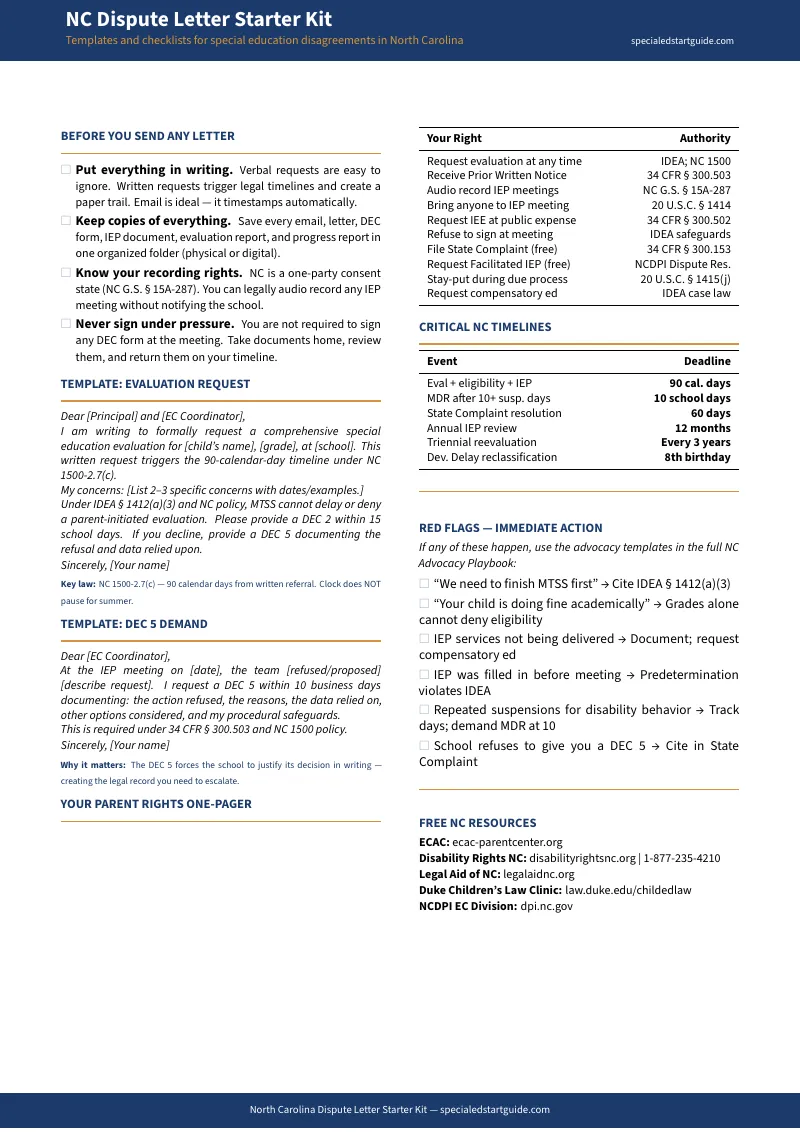
- Dispute Letter Starter Kit (free tier) — Two copy-paste letter templates (evaluation request with MTSS bypass + DEC 5 Prior Written Notice demand), parent rights one-pager with legal citations, and red-flag indicators that signal when to escalate
Instant PDF download. Print the dispute letter that matches your situation tonight. Send it tomorrow morning.
Money-back guarantee, no time limit. If the playbook doesn't change how you handle disputes with your North Carolina school district, email us for a full refund. No questions asked.
Not ready for the full playbook? Download the free North Carolina Dispute Letter Starter Kit — two letter templates citing NC 1500 policies, a parent rights one-pager, and the red flags that signal when informal advocacy isn't enough. It's free.
Your child's education is a legal right, not a negotiation. The district has a system. Now you have the playbook to hold them to it.