
The District Has Lawyers. Now You Have a Playbook.
You tried the collaborative approach. You wrote a polite Parent Concern Statement. You attended the CSE meeting, asked for additional services, and watched the district representative shake her head while the school psychologist read from a script. They offered Prior Written Notice — but only after you demanded it. They refused the Independent Educational Evaluation — and dared you to file for due process. They cut your child's speech therapy from five sessions to two and called it "progress toward least restrictive environment."
You left the meeting knowing something had to change. You Googled "special education attorney New York" and found rates starting at $400 per hour. You called Advocates for Children and were told their direct representation is capacity-limited. You read the Procedural Safeguards Notice and understood about half of it. You found a Facebook group where another parent said, "Just file for due process" — but nobody explained how.
Here's what the district is counting on: that you'll exhaust yourself navigating a system designed to outlast you. That you'll accept the inadequate IEP because the alternative — an impartial hearing, a state complaint, a Carter case — feels impossible without a $500-per-hour attorney. In New York, 98% of all due process complaints filed nationwide originate in this state. The districts are battle-tested. They have legal teams on retainer. And they assume you don't know the rules well enough to fight back.
The New York IEP & 504 Advocacy Playbook is the tactical escalation toolkit for parents who've moved past polite requests and need to enforce their child's rights — with every template, script, and strategy grounded in 8 NYCRR Part 200 and the specific case law that governs New York special education disputes.
What's Inside the Advocacy Playbook
The Dispute Escalation System
When the CSE refuses services, ignores timelines, or predetermines your child's IEP, you have three formal options under New York law: filing a State Complaint with NYSED, requesting mediation through the Office of State Review, or filing a due process complaint for an impartial hearing. Most parents don't know which option fits their situation — or that choosing wrong wastes months. The Playbook maps each pathway with decision criteria, timeline expectations, and the specific regulatory citations you'll need. State complaints are powerful for systemic violations. Mediation works when the district wants to avoid a hearing. Due process is for when you need a legally binding order — and the burden of proof in New York rests on the school district, not on you.
The Pro Se Hearing Toolkit
Filing for an impartial hearing without an attorney is terrifying — but in New York, it's how thousands of parents fight every year. The problem isn't courage; it's procedure. Pro Se parents make avoidable mistakes: they submit evidence incorrectly, ask questions they can't answer on cross-examination, and get outmaneuvered by district attorneys who do this daily. The Playbook provides evidence-organization checklists, direct examination scripts for your own witnesses, cross-examination strategies for school psychologists and CSE chairpersons, and closing brief templates that frame your case under the Endrew F. standard. You won't be guessing what to say at the hearing table.
The Carter/Connors Private School Funding Roadmap
When the public school utterly fails to provide a Free Appropriate Public Education, New York law allows you to place your child in a private special education school and compel the district to reimburse tuition. In fiscal year 2025, Carter-case spending cost New York City $1.3 billion. But a single procedural error — missing the strict 10-business-day notice deadline, failing to articulate the three prongs of the Burlington-Carter test, or neglecting to prove parental cooperation — can cost your family $50,000 or more in forfeited reimbursement. The Playbook provides the exact 10-Day Notice template, the evidence framework for proving the district's failure, and the step-by-step strategy for both Carter (reimbursement) and Connors (direct funding) cases.
The Compliance Enforcement Letters
Every letter in this toolkit triggers a specific legal obligation. Demand compensatory education for services the district failed to deliver — citing the exact Part 200 sections that make recovery mandatory, not optional. Request an Independent Educational Evaluation at public expense using the precise legal phrase that forces the district to either pay or file for a due process hearing to defend their evaluation — there is no third option. File a formal state complaint with NYSED using the required format. Each template includes the regulatory citation, the response timeline, and the follow-up letter for when the district misses the deadline.
The Manifestation Determination Battle Plan
When a child with a disability faces suspension beyond 10 cumulative school days, the district must conduct a Manifestation Determination Review (MDR) to decide whether the behavior was caused by the disability. Districts routinely find "no manifestation" to justify continued exclusion — even when the child's Behavior Intervention Plan was never implemented. The Playbook explains exactly how to challenge a flawed MDR, what evidence to bring, how to demand a Functional Behavioral Assessment, and when to file an expedited due process complaint to protect your child's placement.
NYC vs. Suburban vs. Upstate Dispute Strategies
Fighting the NYC DOE is fundamentally different from challenging a Westchester or Long Island district. In NYC, you're navigating a backlogged impartial hearing system where cases can take over a year to resolve, a district legal team that handles thousands of cases annually, and a Central Based Support Team (CBST) that controls non-public school placements. In suburban districts, you're facing well-funded legal counsel protecting property-tax budgets, with different dynamics around BOCES referrals, out-of-district placement resistance, and classification disputes. Upstate districts bring their own challenges — limited specialized programs, fewer local hearing officers, and reliance on regional BOCES. The Playbook provides region-specific strategies for each landscape.
The Compensatory Education Recovery Guide
When the district fails to deliver mandated services — the speech therapy sessions that never happened, the paraprofessional who was never assigned, the related services that were "unavailable" for months — your child is legally entitled to compensatory education to make up for the lost time. The Playbook explains how to calculate the hours owed, how to document the district's failure, and how to demand recovery through both informal channels and formal complaints. This isn't a future theoretical — the NYC DOE alone faces thousands of compensatory education claims annually.
The Documentation War Room
Every dispute you file, every hearing you attend, every complaint you submit is only as strong as your paper trail. The Playbook provides a structured documentation system: what to save, how to organize it, how to create contemporaneous logs that hold up as evidence, and how to use New York's one-party consent law (NY Penal Law § 250.00) to record every CSE meeting without notifying the school. When you eventually sit across from a district attorney at an impartial hearing, your organized evidence file is the difference between winning and losing.
Who This Playbook Is For
- Parents who've already tried the collaborative approach at the CSE table and been shut down — and who need to escalate with legally grounded strategies, not just louder requests
- Parents preparing for an impartial hearing Pro Se because they cannot afford a special education attorney charging $400–$700 per hour — and who need scripts, evidence checklists, and closing brief templates
- Parents pursuing Carter or Connors private school tuition reimbursement who cannot afford to miss the 10-business-day notice deadline or fail to meet the Burlington-Carter three-prong test
- Parents whose child faces suspension, expulsion, or placement change and who need to challenge a flawed Manifestation Determination Review
- Parents in NYC navigating the DOE's overwhelmed impartial hearing system, chronic related service shortages, and a district legal apparatus that processes thousands of cases per year
- Parents in Westchester, Long Island, and Hudson Valley districts fighting well-funded legal teams that resist costly out-of-district placements and additional service minutes
- Parents upstate who lack access to the specialized attorneys and advocacy organizations concentrated in the downstate market
- Parents seeking compensatory education for services the district failed to deliver — and who need to calculate hours owed and document the district's breach
Why Not Just Use the Free Resources?
New York has excellent free advocacy organizations. Advocates for Children provides direct legal representation. Disability Rights New York publishes a 200-page legal guide. INCLUDEnyc runs workshops. Here's why parents still lose disputes after consulting all of them:
- Free organizations can't represent everyone. Advocates for Children's direct legal services are strictly capacity-bound and income-restricted. If your family earns above their threshold or their caseload is full, you're directed to their published guides — which are informational, not operational. They explain what a due process hearing is. They don't provide scripts for cross-examining the school psychologist.
- The DRNY guide is 200 pages of legal caution. Disability Rights New York's "Special Education in Plain Language" guide is legally accurate and comprehensive. It explicitly states it provides general information, not individual legal advice. It does not include fill-in-the-blank complaint templates, evidence checklists for hearings, or strategies for challenging a Manifestation Determination. It informs parents of their rights without equipping them to enforce those rights.
- Government guides are written by the entity you're fighting. The NYSED Procedural Safeguards Notice and the NYCDOE Family Guide explain how the system is supposed to work under ideal conditions. They do not tell you what to do when the district violates those procedures. They do not advise on how to document failures for litigation. They are compliance documents, not advocacy tools.
- Wrightslaw covers federal law — not New York's 200+ extra rules. Wrightslaw is the gold standard for IDEA. It does not address Part 200 regulations, New York's unique CSE composition requirements, the state complaint process through NYSED, or the impartial hearing procedures governed by the Office of State Review. Generic national advice leaves critical gaps in a New York dispute.
- Generic templates mark you as unprepared. Etsy and TPT offer $5 advocacy letter templates that use federal IDEA language. New York districts operate under Part 200 — a separate and more detailed regulatory framework. Submitting a letter that cites "34 CFR 300" instead of "8 NYCRR 200.4" signals to the CSE that you're working from a generic template, not from knowledge of New York law.
The free resources explain what the law says. The Advocacy Playbook gives you the tools to make the district follow it — or face consequences when they don't.
— Less Than 6 Minutes of a Special Education Attorney
Special education attorneys in New York charge $400–$700 per hour. A private advocate runs $150–$300 per meeting. If you eventually need professional help, the meticulous case file you build with this Playbook saves thousands in billable hours — because you're handing your attorney an organized dispute record with regulatory citations, not a pile of unsigned IEPs and half-remembered conversations from CSE meetings.
Your download includes the complete Advocacy Playbook guide plus standalone printable PDFs — every template, script, checklist, and reference card, ready to use the moment a dispute begins.
- Complete Advocacy Playbook Guide (guide.pdf) — 14 chapters covering the New York advocacy landscape, your legal arsenal under Part 200, CSE power dynamics, evaluation enforcement, IEP goal standards, the NYC placement decoder, Carter/Connors private school funding, dispute resolution pathways, critical transition points, discipline and manifestation protections, upstate and suburban strategies, recording and documentation, advocacy resources, and ready-to-send templates
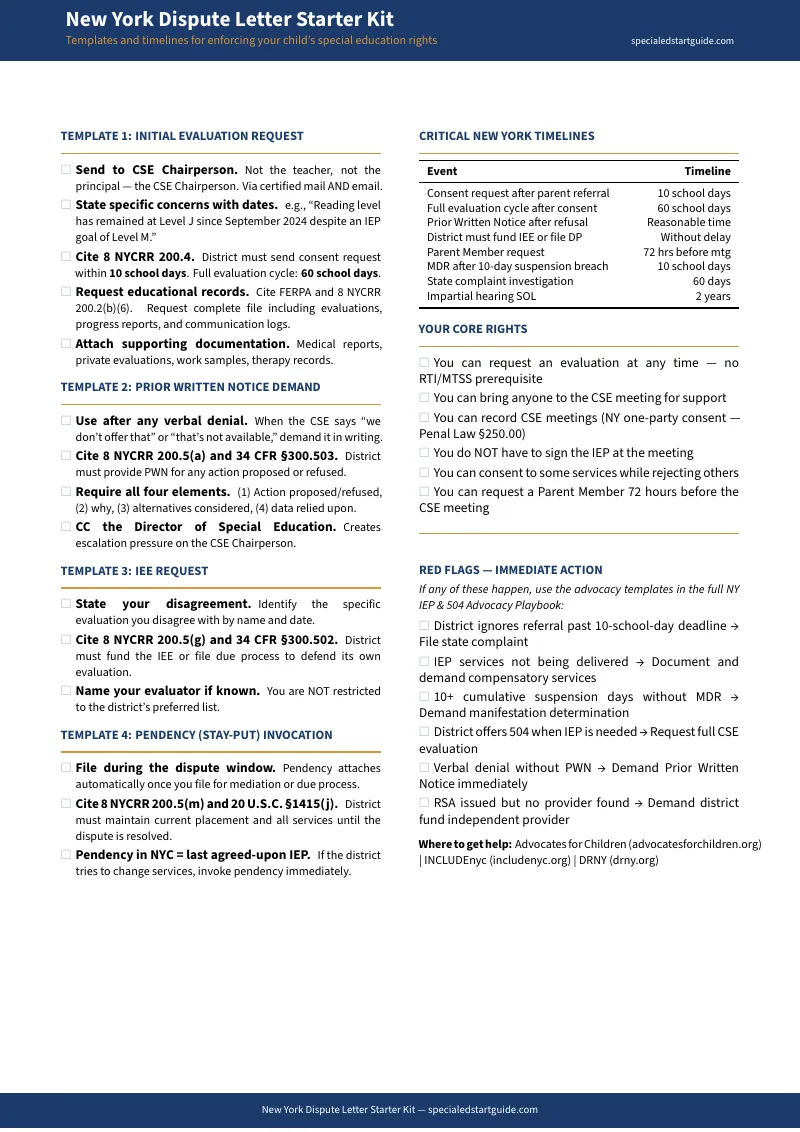
- Dispute Letter Starter Kit (checklist.pdf) — 7 copy-paste templates citing exact Part 200 sections: evaluation requests, Prior Written Notice demands, IEE requests, 10-Day Carter Notice, state complaints to NYSED, parent member requests, and RSA/SETSS tracking logs
- Pro Se Hearing Preparation Checklist (pro-se-hearing-checklist.pdf) — evidence organization, witness preparation, cross-examination strategies, and closing brief framework
- Carter Case 10-Day Notice Template (carter-notice-template.pdf) — the exact letter with Burlington-Carter three-prong language that preserves your tuition reimbursement rights
- Compensatory Education Calculator (compensatory-education-calculator.pdf) — structured worksheet to document missed services and calculate hours owed
- Manifestation Determination Prep Sheet (manifestation-determination-prep.pdf) — evidence checklist and challenge strategy for MDR hearings
- New York Dispute Timeline Reference (dispute-timeline-reference.pdf) — every filing deadline, response window, and appeal period on one page
Instant PDF download. Print the templates tonight. File your complaint tomorrow with the law on your side.
Money-back guarantee, no time limit. If the Playbook doesn't change how you handle special education disputes in New York, email us for a full refund. No questions asked.
Not ready for the full Playbook? Download the free New York Dispute Letter Starter Kit — 7 copy-paste letter templates with Part 200 citations for the most common special education disputes. It's enough to send your first enforcement letter tonight, and it's free.
The district has attorneys on retainer. After tonight, you'll have the same playbook they hoped you'd never find.