
The District Brought a Team of Professionals. You Brought Good Intentions and a 90-Mile Drive.
You sat at one side of the table — across from the special education coordinator, the LEA representative, the general education teacher, and maybe a school psychologist who drove in from the cooperative that morning and will leave for another school in 45 minutes. They used acronyms you'd never heard — PLAAFP, LRE, SDI, ESY. They slid a pre-written IEP across the table and pointed to the signature line. When you asked who's responsible for delivering the speech services — the school or the co-op — both pointed at the other.
When you got home you Googled "Montana IEP rights" and found Disability Rights Montana's Student Rights Handbook (98 pages of legal citations written for lawyers, not parents), the OPI Special Education Guidance document (written for district compliance officers, not families), and a dead link to PLUK — the parent advocacy center that permanently closed in 2019. The Montana Empowerment Center provides free consultations, but you can't wait three business days for a callback when the IEP meeting is tomorrow morning. A private special education advocate charges $100 to $200 per hour. A special education attorney in Montana bills $200 to $400. If you earn too much for free legal aid but not enough for a retainer, you are on your own.
The Montana IEP & 504 Blueprint is the Cooperative Navigation System — the tactical toolkit that bridges the gap between knowing your rights in theory and exercising them at the IEP table, with every template, script, and checklist grounded in Montana's Administrative Rules (ARM Title 10, Chapter 16), the Montana Code Annotated (MCA Title 20, Chapter 7, Part 4), and IDEA.
What's Inside the Blueprint
The Cooperative Service Delivery Decoder
Montana operates 21 Special Education Cooperatives — Bear Paw, Flathead, Gallatin-Madison, Central Montana, and others — because small rural districts can't afford to employ full-time school psychologists, speech-language pathologists, and occupational therapists. Your child attends a local school governed by a local board of trustees, but the therapist delivering IEP services is employed by the cooperative and may drive 120 miles in a single day to reach three different buildings. When services are late, cancelled, or inconsistent, the principal says "talk to the co-op" and the cooperative director says "the district is the LEA." The Blueprint maps exactly who controls scheduling, who bears legal responsibility for FAPE, when to pressure the local superintendent, and when to escalate to the cooperative director — so you stop getting bounced between two bureaucracies while your child's services slip.
The Teletherapy Rights Playbook
Rural Montana districts increasingly default to teletherapy when no SLP, OT, or behavioral specialist is available within 100 miles. Parents are told "this is what we have" without being informed that teletherapy requires documented parental consent in the IEP, that the district must provide a trained paraprofessional to physically assist the child during virtual sessions, and that refusing inadequate teletherapy does not waive your child's right to services. The Blueprint gives you the consent requirements, the IEP language that mandates on-site facilitation support, and the scripts to demand compensatory education when the district provided screen time instead of therapy.
The Small-Town Diplomacy Script Book
In a community of 400 people, the special education director might be your child's basketball coach's spouse. The superintendent sits next to you at church. Filing a state complaint means naming someone you'll see at the hardware store on Saturday. National advocacy guides tell you to "fight the district" — but in rural Montana, burning bridges burns your entire social network. The Blueprint teaches collaborative but firm assertion: how to cite ARM Title 10, Chapter 16 and MCA Title 20, Chapter 7 at the IEP table without alienating the team, how to phrase demands as questions that leave room for partnership, and how to escalate through the dispute ladder without destroying community relationships.
The 60-Calendar-Day Timeline Enforcer
The moment you consent to an evaluation, Montana gives the district 60 calendar days to complete it — that clock runs continuously including weekends, holidays, and school breaks. Districts exploit the timeline by insisting on prolonged RTI observation before starting the evaluation, scheduling assessments in April knowing summer delays will follow, or telling you "the school psychologist from the co-op won't be back until next month." The Blueprint gives you the evaluation request letter that starts the clock, follow-up templates at each checkpoint, and the compliance demand letter citing ARM 10.16.3321 when the 60 days expire without an eligibility determination.
The Copy-Paste Advocacy Letter Library
Every letter cites the exact Montana regulation. Request a formal evaluation and start the 60-calendar-day clock. Demand an Independent Educational Evaluation at public expense. Request a Functional Behavioral Assessment. Document constructive removal when the school sends your child home early without logging it as a suspension. Demand Prior Written Notice when the district verbally refuses a service. These are Montana enforcement tools that create a legally binding paper trail the moment you hit send.
IEP Meeting Scripts and Checklists
What to say when the team tells you your child doesn't qualify because their grades are passing. What to say when they push a 504 instead of an IEP. What to say when the LEA representative claims they can't add service minutes "because of staffing." What to say when the co-op therapist wasn't invited to the meeting. Each script cites the ARM Title 10, Chapter 16 or MCA regulation that proves them wrong — so you're not arguing opinions at the table, you're citing Montana law. The pre-meeting checklist covers Montana's one-party consent recording rules under MCA 45-8-213, required IEP team composition, and the specific documents to bring.
The Tribal School Jurisdiction Roadmap
Montana encompasses eight federally recognized tribes across seven reservations. Students attending local public school districts on or near reservations are governed by OPI rules. Students enrolled in Bureau of Indian Education (BIE) operated or grant-funded schools bypass OPI entirely — their oversight comes from the BIE's Division of Performance and Accountability. For Native American families who may attend a BIE school one year and transfer to a public district the next, the procedural whiplash is disorienting. The Blueprint maps both pathways, explains which protections apply where, and provides the specific advocacy tools for securing FAPE regardless of which system your child is in.
Goal-Tracking Worksheets
IEP goals are legally required to be measurable — with baselines, targets, and mastery criteria that meet the Endrew F. standard. But many goals in Montana are written so vaguely that progress is impossible to track, especially when the therapist delivering services changes each semester as cooperative staff turn over. The worksheets give you a structured format to log data between meetings, compare school-reported progress against your own observations, and arrive at the annual review with documentation that either confirms the program is working or proves it isn't.
Who This Blueprint Is For
- Parents preparing for their first IEP meeting who don't want to walk in blind against a team that does this every day — and who need to understand the IEP document before it's discussed at the table
- Parents whose child has been pushed into a 504 Plan when they should be receiving specially designed instruction under an IEP — especially when the school says "let's try accommodations first"
- Parents in Billings, Missoula, Great Falls, Bozeman, or Helena where districts are better staffed but overcrowded classrooms mean 10–15% of students need IEP or 504 support and the system is backlogged
- Parents in frontier and small-district Montana — Class C schools, one-room districts, communities where the itinerant SLP visits once a week for 30 minutes and the nearest BCBA is two hours away — who are told "we don't have the staff" for every unmet service
- Parents on or near Montana's seven reservations navigating overlapping public school and BIE jurisdictions, where documented systemic discrimination compounds the difficulty of securing FAPE
- Parents whose child has ADHD, autism, dyslexia, or anxiety and was told they're "too smart for special education" or "grades are too high" — and who need to understand that academic performance is not the legal standard
- Parents whose child was suspended without a Manifestation Determination Review — or who is being sent home early every week without anyone calling it a suspension
- Parents stuck in RTI purgatory — the school insists on prolonged Response to Intervention while the child falls further behind, and you need the legal citation proving RTI cannot delay an evaluation request
Why Not Just Use the Free Resources?
Montana has genuine free special education resources. The Montana Empowerment Center (MEC) offers webinars and phone consultations. Disability Rights Montana (DRM) provides legal advocacy for severe cases. OPI publishes procedural safeguards documents. Here's why parents still struggle after consulting all of them:
- PLUK closed permanently in 2019. For decades, Parents Let's Unite for Kids was the go-to resource Montana parents were told to call. It no longer exists. Older forum posts, Facebook groups, and school handouts still reference PLUK — leading desperate parents to dead links and disconnected phone numbers at the worst possible moment.
- MEC operates at grant-funded capacity limits. The Montana Empowerment Center provides high-quality training, but they serve the entire state with limited staff. An anxious parent facing an adversarial IEP meeting tomorrow morning cannot wait days for a consultation callback, nor do they have the bandwidth to watch a 45-minute archived webinar at 11 PM.
- The DRM Student Rights Handbook is a legal textbook, not a toolkit. At nearly 100 pages of continuous legal citations (CFR, MCA, ARM), it explains what Montana law says — but doesn't give you the email template to send tonight or the script to use at tomorrow's meeting. It's written for lawyers, not exhausted parents.
- OPI publications are written for compliance officers, not parents. The OPI Special Education Guidance document ensures the district passes its audit. It does not help you navigate the system as a parent advocate.
- Wrightslaw covers federal law — not ARM Title 10, Chapter 16 or MCA Title 20. Wrightslaw doesn't address Montana's cooperative service model, teletherapy consent requirements, tribal school jurisdictions, or the specific dispute resolution procedures through OPI. Using national terminology without understanding Montana's implementation signals to the district that you don't know your local rights.
- TPT and Etsy planners organize paperwork — they don't enforce rights. A pastel IEP binder won't explain why the school is pushing a 504, how to hold the cooperative accountable for missed sessions, or how to cite ARM 10.16.3321 when the 60-day evaluation timeline expires.
- Private advocates cost $100–$200 per hour in Montana. Attorneys run $200–$400. Most families can't afford that — and advocates prefer cases where a solid paper trail already exists. The Blueprint is how you build that trail.
The free resources explain what Montana law says. The Blueprint gives you the tools to make the district follow it.
— Less Than One Hour of a Special Education Advocate
Private advocates in Montana charge $100–$200 per hour. Special education attorneys run $200–$400. If you hand an advocate a disorganized pile of papers, you'll spend hundreds just for them to review the file and formulate a strategy. The Blueprint teaches you how to organize the binder, decode the IEP document, and draft the initial requests — either empowering you to advocate effectively without an advocate, or saving significant billable hours if you do hire one.
Your download includes the complete Blueprint guide, the meeting prep checklist, and standalone printables — every template, script, and reference ready to print and bring to your next IEP meeting.
- Complete Blueprint Guide — 15 chapters covering the Montana special education landscape, IEP vs. 504, referral and evaluation timelines (60-calendar-day evaluation clock), the IEP document walkthrough, goals and progress monitoring, the cooperative service delivery model, teletherapy rights, accommodations and related services, discipline and Manifestation Determinations, ESY services, transition planning, dispute resolution through OPI, documentation strategies, Independent Educational Evaluations, tribal school jurisdiction roadmap, Montana resources, and a complete templates and scripts library
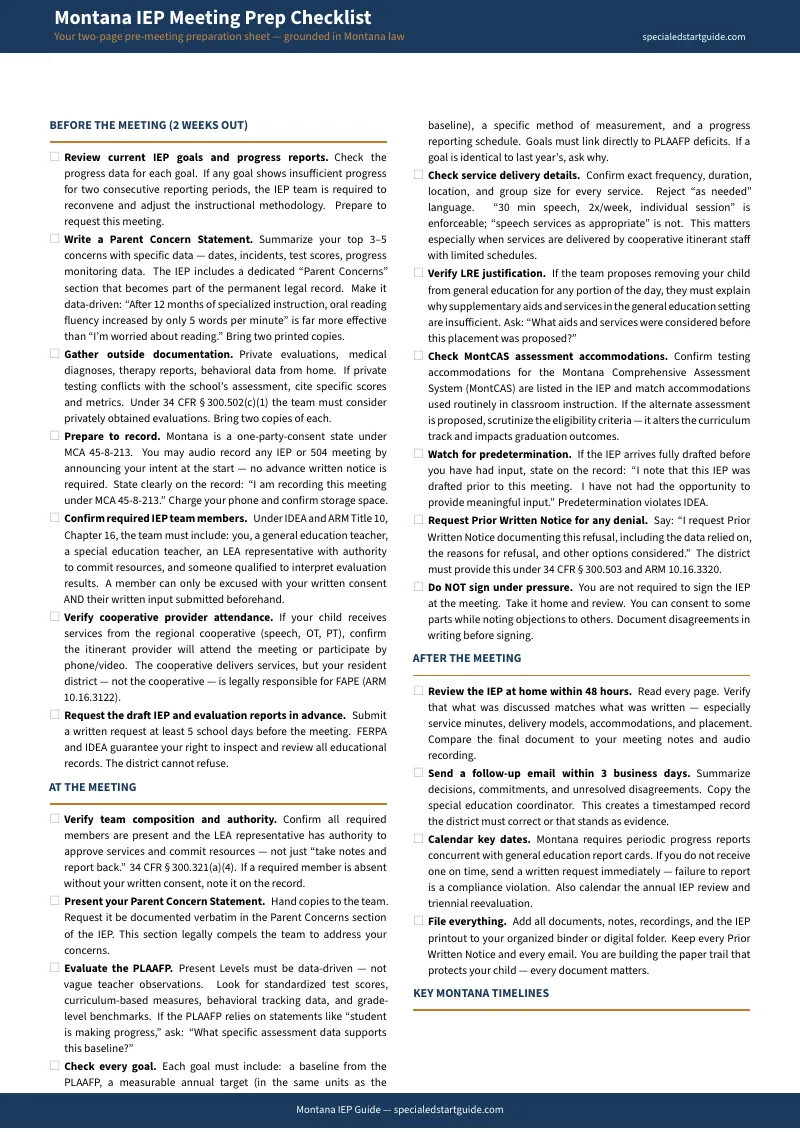
- IEP Meeting Prep Checklist — the before/during/after checklist with Montana timelines, IEP team composition requirements, and recording rights under MCA 45-8-213
- 60-Day Timeline Enforcer — the complete evaluation-to-services timeline on one printable sheet, with checkpoint actions and the RTI bypass script citing IDEA 300.301(b)
- Copy-Paste Advocacy Letters — fill-in-the-blank templates ready to send: Evaluation Request, Prior Written Notice Demand, IEE Request, Cooperative Service Complaint, and Follow-Up Email
- IEP Meeting Scripts — word-for-word responses to "we need to do RTI first," IEP-to-504 downgrades, staffing excuses, and cooperative buck-passing
- Goal-Tracking Worksheets — structured progress monitoring for up to 6 IEP goals with data collection rows, a service delivery log, and annual review summary
- Cooperative Accountability Reference — the escalation ladder for Montana's cooperative service delivery model, who bears responsibility for FAPE, and the buck-passing script
- Teletherapy Rights Reference — consent requirements, IEP language for paraprofessional support, compensatory education scripts, and quality safeguards
- Dispute Resolution Roadmap — the full escalation path from reconvened IEP meeting through OPI Early Assistance, OPI State Complaint, mediation, and due process hearing
Instant PDF download. Print the standalone templates tonight. Walk into tomorrow's IEP meeting with the law on your side.
Money-back guarantee, no time limit. If the Blueprint doesn't change how you approach IEP meetings in Montana, email us for a full refund. No questions asked.
Not ready for the full Blueprint? Download the free Montana IEP Meeting Prep Checklist — a printable pre-meeting checklist with Montana timelines, IEP team composition requirements, one-party consent recording rules under MCA 45-8-213, and red flags that require immediate action. It's enough to walk into your next meeting prepared, and it's free.
Your child's education is a legal right, not a favor. The district knows ARM Title 10, Chapter 16 and MCA Title 20, Chapter 7. After tonight, so will you.