
You Live in the State That Invented Special Education Law. The District Still Told You "We Don't Do That Here." Here's How to Prove They Do.
You sat across from the Team — the Director of Special Education, the school psychologist, the general education teacher, the speech therapist, the principal, and the LEA representative — and they told you your child was "making effective progress in the general curriculum." But your fifth-grader still reads at a first-grade level. The Orton-Gillingham reading services the last IEP promised haven't been delivered since October because "the provider is out." You asked for an Independent Educational Evaluation and the Director said no. You asked to record the meeting and they said Massachusetts is a two-party consent state, so recording isn't permitted. You asked for an N-2 Notice documenting the refusal and got blank stares.
You are not imagining this. Massachusetts identifies roughly 19.7% of its public school students as eligible for special education — one of the highest rates in the country. The Bureau of Special Education Appeals logged 14,577 rejected-IEP notifications in FY 2024 alone. Parents filed over 1,000 BSEA mediation requests. In FY 2025, parents prevailed in only 5 of 29 fully litigated BSEA due process decisions — districts prevailed in 17, and 7 were mixed. Massachusetts special education attorneys charge $300 to $500+ per hour and require retainers of $5,000 to $10,000. Non-attorney advocates charge $100 to $300 per hour, and a 90-minute introductory consultation runs $200.
If you earn too much for free legal aid through the Disability Law Center and not nearly enough for a Boston-area attorney's retainer, you are navigating the most active — and most adversarial — special education system in the country entirely alone, unless you know exactly how to use Massachusetts' own regulations against the district.
The Massachusetts IEP & 504 Advocacy Playbook is the 603 CMR 28.00 Dispute System — the tactical toolkit that turns overwhelmed parents into effective pro se advocates by providing the exact dispute letters, N-1/N-2 scripts, PRS complaint narratives, BSEA mediation prep, and paper trail protocols grounded in M.G.L. c. 71B, 603 CMR 28.00, and 603 CMR 46.00 that force Massachusetts school districts to respond on the record.
What's Inside the Playbook
The N-2 Partial Rejection Toolkit
Most Massachusetts parents don't know that partially rejecting an IEP — accepting the services you want implemented while rejecting specific omissions — triggers automatic BSEA notification under 603 CMR 28.08(3) and preserves stay-put rights on the last-agreed IEP. It's the single most powerful tactical move in Massachusetts advocacy, and the district almost never mentions it. The Playbook includes the exact partial-rejection signature-page language, the cover letter that documents your reasoning with evaluator citations, and the follow-up demand for an N-2 Notice of Refusal that creates binding written evidence for mediation or hearing.
The Fill-in-the-Blank Dispute Letter Library
Every letter cites the exact Massachusetts regulation. Demand an Independent Educational Evaluation at public expense — using the specific legal language under 603 CMR 28.04(5) that triggers the district's obligation to either fund the IEE or file a BSEA hearing within 5 school days to prove its evaluation was appropriate. Request N-1 Prior Written Notice for every denial under 34 C.F.R. §300.503 and 603 CMR 28.05. Document service non-delivery with the specific citations that substantiate a PRS complaint. File your BSEA Hearing Request with the *Schaffer v. Weast* burden-of-proof framing and *Endrew F.* "reasonably calculated" language hearing officers credit. These aren't generic Wrightslaw federal templates — they cite the Massachusetts regulations that DESE and BSEA investigators check line by line.
The Two-Party Consent Recording Protocol
Massachusetts M.G.L. c. 272, § 99 is one of the strictest two-party consent wiretap statutes in the country — secret recording of a Team meeting is a felony and the recording is inadmissible at BSEA. But transparent consent (announcing the recording on the record and proceeding only with unanimous written agreement) is legal and routinely used by attorneys. The Playbook includes the pre-meeting Notice of Intent to Record, the written-consent form for each participant, the verbal script to open the meeting on the record, and the non-recording fallback — the 24-hour Letter of Understanding rule that converts every oral commitment into documented evidence when the district refuses to allow recording.
The Paper Trail System
In Massachusetts, under *Schaffer v. Weast*, the burden of proof at a BSEA hearing falls on the moving party — usually the parent. With parents prevailing in only about 17% of fully litigated FY 2025 decisions, your paper trail is your case. The Playbook includes communication logs, Letter of Understanding templates for every meeting, the 24-hour email rule that converts verbal district statements into written admissions, and a systematic five-section advocacy binder protocol that builds the evidence BSEA hearing officers actually credit.
The DESE Problem Resolution System (PRS) Complaint Kit
A PRS State Complaint is free, does not require an attorney, and frequently produces faster results than BSEA. You file it with DESE's Problem Resolution System — which must issue a Letter of Finding within 60 calendar days (though federal audits have documented systematic DESE delays, and the Playbook tells you how to escalate to OSEP when they miss the deadline). The complaint must be filed within one year of the alleged violation. The Playbook explains which violations are best suited for PRS versus BSEA mediation versus due process, how to frame the complaint narrative with the specific 603 CMR 28.00 citations that substantiate a violation finding, what evidence to attach, and the common mistakes that result in dismissed complaints.
The BSEA Mediation, Advisory Opinion, and Settlement Conference Playbook
BSEA achieved an 82% settlement rate across 765 mediations in FY 2024 — the arena where pro se parents actually win. The newly-updated BSEA rules explicitly opened Settlement Conferences to pro se (unrepresented) parents — a major 2024 change most parents don't know about. Advisory Opinions let a hearing officer preview how your case would likely resolve before you commit to formal due process. The Playbook demystifies all three, covers mediation prep strategy, the opening statement template, the settlement-term provisions that matter, and the BSEA hearing officer database that tells you whose reasoning your case will likely face.
The Manifestation Determination and Restraint Prep Kit
When a student with an IEP is removed from placement for more than 10 cumulative school days in a year, the district must conduct a Manifestation Determination Review within 10 school days. The MDR Team must answer two legal questions: Was the behavior caused by or substantially related to the disability? Was the behavior a direct result of the district's failure to implement the IEP? If yes to either, the behavior is a manifestation — and the child cannot be further disciplined. The Playbook walks you through preparing for the MDR, requesting a Functional Behavioral Assessment, demanding a Behavior Intervention Plan, and protecting your child under 603 CMR 46.00 — Massachusetts' strict restraint and seclusion rules prohibiting prone restraint, mechanical restraint, and seclusion in public schools, with 3-school-day written notification requirements.
The Chapter 766 Out-of-District Placement Roadmap
Chapter 766 Approved Private Schools exist because Massachusetts districts have been unable to serve every profile in-district since 1972. Getting your child into one requires a failure-based paper trail, the Carter/Burlington three-prong test (district failed to provide FAPE + your chosen placement is appropriate + equitable considerations favor reimbursement), and — if you ultimately unilaterally place — the mandatory 10-business-day notice that preserves your tuition reimbursement rights. The Playbook gives you the multi-year documentation protocol, the OOD request letter, and the First Circuit case law that corners a resistant district.
The Transition Planning and Chapter 688 Protocol
Massachusetts mandates transition planning at age 14 under 603 CMR 28.05(4)(c) — two years earlier than federal IDEA. The Chapter 688 Referral must be filed with DDS, MassAbility, MCB, or DMH at least two years before the student turns 22 or graduates with a standard diploma — and missing that 2-year window usually means an 18-month wait list for adult services. The Playbook includes the Chapter 688 referral demand, the IEP transition element audit, and the diploma-vs-certificate decision framework that protects continued services through age 22.
Forum Selection — Because the Wrong Dispute Forum Costs You Months
PRS is faster for compliance violations but can be a trap if your real dispute is substantive. BSEA Mediation is free, confidential, and settles 82% of cases. Advisory Opinions are low-cost case previews. Settlement Conferences (newly open to pro se parents) are lower-friction than full hearings. Due Process Hearings require formal adjudicatory procedure under 801 CMR 1.01 and are brutal for unrepresented parents. The Playbook's forum-selection flowchart tells you which dispute belongs where — and when to sequence PRS before BSEA for maximum leverage.
Urban vs. Suburban District Advocacy Dynamics
Advocating in Boston Public Schools — a system serving 10,000+ students on IEPs with chronic staffing shortages — requires a different approach than Newton, Lexington, Wellesley, or Concord, where well-funded districts retain sophisticated corporate counsel (firms like Murphy Hesse Toomey & Lehane) to fight every out-of-district placement request. Springfield, Worcester, Lawrence, Lynn, Brockton, and Fall River face Gateway-city realities where the 30-school-day evaluation deadline routinely blows past because positions are vacant. The Playbook maps the tactical angles for each region — because the same 603 CMR 28.00 regulation means something very different in each.
Who This Playbook Is For
- Parents whose child was denied eligibility because she is "making effective progress in the general curriculum" — and who need the exact Massachusetts framing that defeats this defense by citing 603 CMR 28.02(17)'s holistic effective-progress definition, including social/emotional and individual-potential factors
- Parents whose IEP services are not being delivered — the speech therapist position has been vacant for months, the aide covers multiple classrooms, the Orton-Gillingham goals haven't changed in two years — and who need the N-2 demand, service log records request, and PRS complaint narrative that forces compliance
- Parents facing disciplinary action against their child — suspensions, alternative placements, restraint or seclusion incidents under 603 CMR 46.00 — who need to understand Manifestation Determination Reviews and protect their child's stay-put rights
- Parents in Boston, Springfield, Worcester, Lawrence, Lynn, Brockton, Fall River, or another Gateway City dealing with systemic compliance failures who need the documentation that escalates to DESE effectively
- Parents in Newton, Lexington, Wellesley, Concord, Brookline, Weston, or another affluent suburban district facing sophisticated bureaucratic resistance — where the district has retained corporate counsel to fight your out-of-district placement because the Chapter 766 tuition exceeds $90,000 per year
- Parents who walked into a Team meeting alone, were handed a pre-written IEP, and signed under time pressure because no one explained Partial Rejection under 603 CMR 28.08(3) or the stay-put provisions that protect services during the dispute
- Parents who tried to record their Team meeting, were told Massachusetts is a two-party consent state so recording is forbidden, and never learned that transparent consent under M.G.L. c. 272, § 99 is legal and routinely used by attorneys and sophisticated advocates
- Parents whose child turns 14 this year and the Team has not mentioned transition planning, vocational assessment, or the Chapter 688 referral — and who need the MA-specific transition audit before the 2-year Chapter 688 filing window closes
- Parents who filed a PRS complaint six months ago and DESE has not issued a Letter of Finding — and who need the escalation path to the federal Office of Special Education Programs (OSEP)
- Parents whose child has a 504 Plan but should have an IEP — and who need the evaluation request that starts the 5-school-day and 30-school-day clocks under 603 CMR 28.04
- Parents offered a BSEA mediation date who don't know whether mediation is a trap, a gift, or the necessary step before filing for due process — and who need the mediation opening statement and settlement-term framework
- Parents considering unilateral placement at a Chapter 766 private school — who need the failure-based paper trail, the Carter/Burlington three-prong test, and the 10-business-day notice that preserves tuition reimbursement
- Parents who feel outnumbered at every Team meeting and need the exact words to say when the district denies a request, refuses an evaluation, or invokes the "We don't do that in this district" excuse
Why Not Just Use the Free Resources?
Massachusetts has excellent free advocacy resources. The Federation for Children with Special Needs (FCSN) publishes a comprehensive Parent's Guide to Special Education developed in collaboration with DESE. Massachusetts Advocates for Children (MAC) produces outstanding issue-specific reports on autism bullying, trauma-sensitive schools, and bilingual rights. The Disability Law Center (DLC) offers free legal representation. The BSEA publishes a Pro Se Litigant Manual. Here's why Massachusetts parents still lose disputes after consulting all of them:
- FCSN is federally funded and works in collaboration with DESE. Their guidance is neutral by design — they teach you how the system is supposed to work cooperatively. They will not give you the fill-in-the-blank N-2 Partial Rejection script, the transparent-consent recording workaround, or the PRS complaint narrative that triggers corrective action. The tone is diplomatic; you need tactical.
- MAC and DLC do impact litigation and triage by grant-funding priorities. They do exceptional work for the cases they take — but they cannot represent every Massachusetts family, and they are not going to attend your Team meeting next Tuesday. Their intake processes are selective and often capacity-limited for months.
- The BSEA Pro Se Litigant Manual references 801 CMR 1.01. It discusses subpoena practice, motion filings, and Massachusetts Administrative Procedure Act formal adjudicatory rules. It terrifies parents into compliance rather than teaching them that BSEA Mediation (82% settlement rate), Advisory Opinions, and the newly pro-se-accessible Settlement Conferences are where parents actually win without an attorney.
- Wrightslaw is national — not Massachusetts-specific. Wrightslaw is the gold standard for federal IDEA. It does not cover 603 CMR 28.00, the new 2024-2025 Massachusetts IEP form, the N-1/N-2 Notice forms, the 5-school-day consent timeline, the 30-school-day evaluation deadline, the M.G.L. c. 272, § 99 two-party consent statute, the DESE Problem Resolution System, the BSEA Advisory Opinion process, Chapter 766 approved private schools, the Carter/Burlington test as applied in the First Circuit, or the Chapter 688 transition referral rule. Federal citations help; Massachusetts-specific citations tell the district you know their playbook.
- Massachusetts special education attorneys cost $300 to $500+ per hour with $5,000 to $10,000 retainers. A fully litigated BSEA due process hearing can exceed $50,000 in attorney's fees. Non-attorney advocates charge $100 to $300 per hour; a single consultation runs $200. Under IDEA, parents cannot recover non-attorney advocate fees — even if you win. The financial asymmetry is uniquely punishing in this state.
The free resources explain what Massachusetts law says. This Playbook gives you the dispute tools to make the district comply.
— Less Than One Hour of a Massachusetts Advocate
Private advocates in Massachusetts charge $100 to $300 per hour. Educational attorneys run $300 to $500+. A single 90-minute consultation costs $200 before any work begins. The Playbook gives you the dispute letters, forum-selection flowchart, BSEA mediation prep, and documentation system that advocates use — so you can either handle the dispute yourself or arrive at a paid consultation with an organized case file that saves hundreds in billable hours.
Your download includes the complete 12-chapter Advocacy Playbook guide plus standalone printable PDFs — every dispute letter template, escalation checklist, and reference card, ready to print and use tonight.
- Complete Advocacy Playbook Guide — 12 chapters covering the Massachusetts legal framework, the six procedural safeguards that matter most, the new 2024-2025 IEP form, evaluation requests and IEEs, Team meeting tactics and two-party consent recording, partial rejection and stay-put, forum selection (PRS vs. BSEA mediation vs. Advisory Opinion vs. Settlement Conference vs. due process), out-of-district placement under Chapter 766 and the Carter/Burlington standard, discipline/MDR/restraint under 603 CMR 46.00, transition planning at 14 and Chapter 688 referrals, and the paper trail system that wins at BSEA
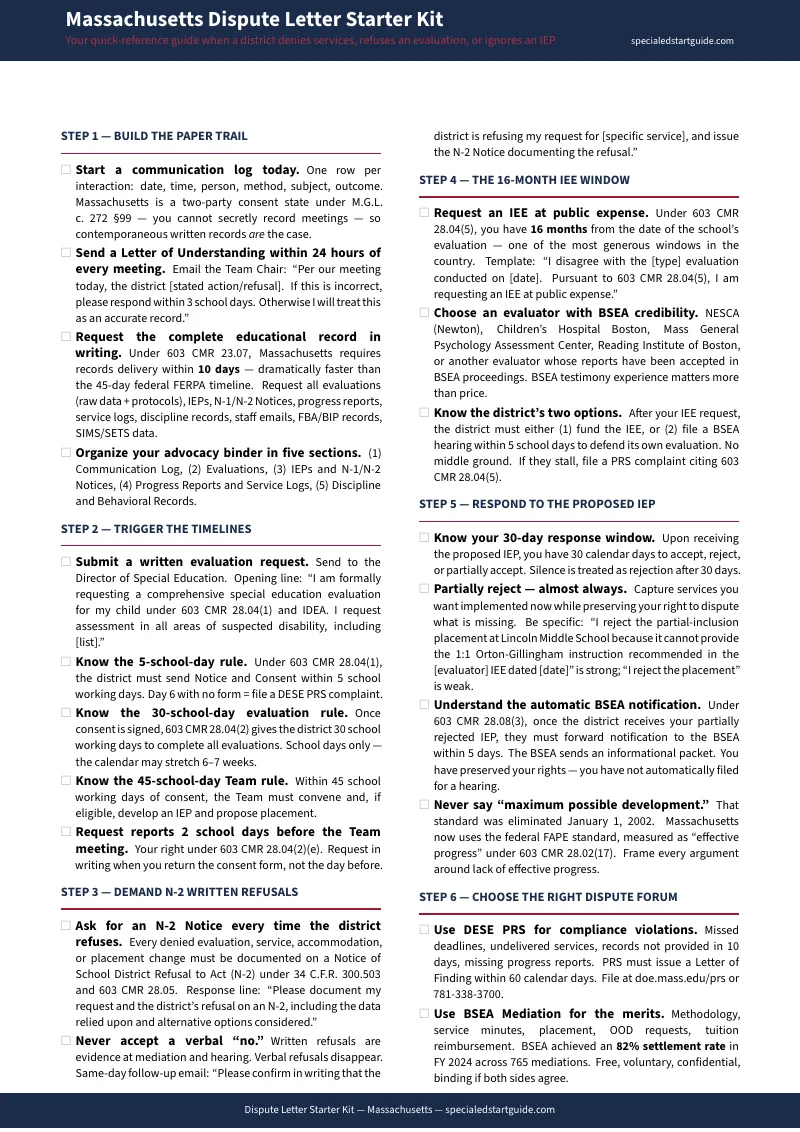
- Massachusetts Dispute Letter Starter Kit — quick-reference 8-step escalation checklist, Massachusetts timeline table (5/30/45 school-day deadlines, 60-day PRS, 75-day BSEA, 2-year statute of limitations), and a fill-in-the-blank dispute letter template citing 603 CMR 28.00 and M.G.L. c. 71B
- Advocacy Letter Templates — fill-in-the-blank letters citing exact 603 CMR 28.00 regulations for evaluation requests, IEE demands, N-1 Prior Written Notice demands, N-2 Partial Rejection, service non-delivery documentation, and formal disagreements
- PRS State Complaint Template — structured DESE complaint narrative with required elements, evidence attachment guide, the one-year filing deadline, and OSEP escalation language when DESE misses the 60-day timeline
- BSEA Hearing Request Template — the opening pleading citing *Schaffer v. Weast* and *Endrew F.*, framed around "effective progress" rather than the defunct MPD standard
- Communication Log and Letter of Understanding Templates — printable documentation trackers and the 24-hour follow-up email protocol that converts every verbal conversation into a written record
- Recording Notice Packet — the transparent-consent Notice of Intent to Record, the written-consent form for each Team participant, and the verbal script to open the meeting on the record under M.G.L. c. 272, § 99
- MDR Preparation and Restraint Response Checklists — step-by-step Manifestation Determination Review preparation including the two legal questions, FBA demand templates, BIP review protocol, and the 603 CMR 46.00 restraint incident response
- Dispute Escalation Ladder — visual roadmap from informal resolution through Letter of Understanding, N-2 demand, PRS State Complaint, BSEA Mediation, Advisory Opinion, Settlement Conference, Due Process Hearing, and OCR Region I complaint — with Massachusetts-specific timelines at every stage
- Chapter 766 OOD and Chapter 688 Transition Templates — the out-of-district placement demand, the Carter/Burlington 10-business-day unilateral placement notice, and the Chapter 688 referral demand to DDS, MassAbility, MCB, or DMH
Instant PDF download. Print the dispute letter that matches your situation tonight. Send it tomorrow morning.
Money-back guarantee, no time limit. If the Playbook doesn't change how you handle disputes with your Massachusetts school district, email us for a full refund. No questions asked.
Not ready for the full Playbook? Download the free Massachusetts Dispute Letter Starter Kit — an 8-step printable checklist covering paper trail setup, the 5/30/45-school-day timelines, core procedural rights under 603 CMR 28.00, evaluation challenges, discipline protections, and escalation steps. It's enough to start building your case tonight, and it's free.
Your child's right to a Free Appropriate Public Education under IDEA, M.G.L. c. 71B, and 603 CMR 28.00 is enforceable — but only if you write it down and file it the right way. This Playbook puts those tools in your hands.