
The District Brought Eight People to Your IEP Meeting. You Brought Good Intentions. Here's How to Bring the Law.
You sat across from the IEP team — the special education coordinator, the school psychologist, the general education teacher, the speech therapist, the assistant principal, and the LEA representative — and they told you your child was "making adequate progress." But your fifth-grader still reads at a first-grade level and the progress reports say "achieving 70% in 3 out of 5 trials" without explaining what that means or why nothing has changed. You asked for an Independent Educational Evaluation and they said no. You asked to record the meeting and they told you to put your phone away. You asked the team to document their refusal and got blank stares.
You are not imagining this. Maryland serves over 111,000 students in special education across 24 local education agencies — and the gap between what federal and state law guarantees and what families actually receive is enormous. Data from the MSDE Office of the Inspector General shows 583 formal complaints in a single recent reporting period. Prince George's County generated 93 complaints. Baltimore County, 72. Baltimore City, 62. Parents lose over 80% of due process hearings before Maryland's Office of Administrative Hearings. And special education attorneys in Maryland charge an average of $344–$349 per hour, with retainers exceeding $5,000–$10,000.
If you earn too much for free legal aid through Disability Rights Maryland and not nearly enough for an attorney's retainer, you are navigating one of the most adversarial systems in state government entirely alone — unless you know exactly how to use Maryland's own regulations against the district.
The Maryland IEP & 504 Advocacy Playbook is the COMAR Dispute System — the tactical toolkit that turns overwhelmed parents into effective advocates by providing the exact dispute letters, escalation procedures, and paper trail protocols grounded in COMAR 13A.05.01, IDEA, and Section 504 that force Maryland school districts to respond on the record.
What's Inside the Playbook
The Five-Day Document Rule Enforcement Kit
Maryland law requires the school to provide all assessments, reports, data charts, and draft IEPs at least five business days before your meeting. This is one of the strongest procedural safeguards in the country — and most parents don't know it exists. The Playbook includes the exact demand letter to send when documents arrive late, plus the template to postpone the meeting on the record. Districts that violate this timeline have already created the first documented procedural violation for a state complaint.
The Fill-in-the-Blank Dispute Letter Library
Every letter cites the exact Maryland regulation. Demand an Independent Educational Evaluation at public expense — using the specific legal language under COMAR 13A.05.01.06 that triggers the district's obligation to either fund the IEE or file for due process within 30 days to defend their evaluation. Request Prior Written Notice for every denial — because the district is required under IDEA §300.503 and COMAR to explain in writing what they refused, why, what data they relied on, and what alternatives they considered. Document service non-delivery with the specific COMAR citations that prove the district violated the IEP. These aren't generic federal templates — they cite the Maryland regulations that MSDE investigators check during state complaint investigations.
The Maryland Meeting Recording Protocol
Maryland is a strict all-party consent state under the Wiretap Act. You cannot simply press record on your phone. Districts like Montgomery County require 72 hours of written notice, prohibit video recording entirely, and must counter-record any session. The Playbook includes the exact 72-hour notice email template, a district-by-district reference for recording policies, and the workarounds that protect your rights when recording is blocked — including how to bring a support person as a dedicated note-taker and how to use follow-up emails to document what was said.
The Paper Trail System
In Maryland, the burden of proof at OAH falls entirely on the parent. With only a 19% win rate, your paper trail is your case. The Playbook includes communication logs, follow-up email templates for every verbal conversation, and a systematic documentation protocol that builds the evidence OAH hearing officers require. Every phone call gets a summary email. Every meeting gets a written follow-up. Every denial triggers a Prior Written Notice demand. Districts respond differently when they know the parent is documenting everything.
The Manifestation Determination Prep Kit
When a student with a disability is removed from placement for more than 10 cumulative school days in a year, the district must conduct a Manifestation Determination Review within 10 school days. The MDR team must answer two legal questions: Was the behavior caused by or substantially related to the disability? Was the behavior a direct result of the district's failure to implement the IEP? If yes to either, the behavior is a manifestation — and the child cannot be expelled. The Playbook walks you through preparing for the MDR, requesting a Functional Behavioral Assessment, demanding a Behavioral Intervention Plan, and protecting your child from the seclusion and restraint practices restricted under Maryland's Education Article §7-1101 through §7-1104.
The MSDE State Complaint Filing Guide
An MSDE State Complaint is free, does not require an attorney, and frequently produces faster results than due process. You file it with the Maryland State Department of Education Division of Early Intervention and Special Education Services. MSDE has 60 calendar days to investigate and issue a decision. The complaint must be filed within one year of the alleged violation — a critical deadline that many families miss. The Playbook explains which violations are best suited for state complaints versus mediation versus due process, how to frame the complaint narrative for maximum impact, what evidence to attach, and the common mistakes that result in dismissed complaints.
The Due Process Hearing Roadmap
Due process at OAH is the highest administrative remedy before federal court. The statute of limitations is two years from the date you knew or should have known about the violation. The district must hold a resolution meeting within 15 days, and the 30-day resolution period must expire before the hearing timeline begins. Your child stays in their current placement during the entire process — the stay-put provision. The Playbook covers resolution session strategy, evidence organization, what OAH Administrative Law Judges look for, and how to build a case that survives the preponderance-of-evidence standard.
County-Specific Advocacy Dynamics
Advocating in Baltimore City — a district operating under the Vaughn G. federal consent decree with chronic compliance failures — requires a different approach than Montgomery County, where a sophisticated bureaucracy uses "Central IEP" committees to limit expensive placements. Prince George's County is under intensive MSDE monitoring. Howard County's affluent reputation masks rigid gatekeeping. The Playbook maps the administrative culture, complaint volumes, and tactical angles for the districts where most Maryland families advocate.
Who This Playbook Is For
- Parents whose child was denied special education eligibility despite clear academic, behavioral, or functional struggles — and who need to challenge the evaluation or request an IEE at public expense
- Parents whose child's IEP services are not being delivered — the speech therapist position has been vacant for months, the aide covers multiple classrooms, the goals haven't changed in two years — and who need the paper trail that forces accountability
- Parents facing disciplinary action against their child — suspensions, alternative placements, restraint or seclusion incidents — who need to understand Manifestation Determination Reviews and protect their child's right to stay in placement
- Parents in Baltimore City or Prince George's County dealing with systemic compliance failures and who need the documentation that escalates to MSDE effectively
- Parents in Montgomery, Howard, or Anne Arundel County facing sophisticated bureaucratic resistance that denies services through administrative process rather than outright refusal
- Parents on the Eastern Shore or in rural counties where chronic staffing shortages mean services are simply not delivered — and who need to demand compensatory education for missed sessions
- Parents who feel outnumbered at every IEP meeting and need the exact words to say when the team denies a request, refuses an evaluation, or claims the budget won't allow it
- Military families at Fort Meade or Aberdeen Proving Ground navigating disputes with an unfamiliar Maryland district
Why Not Just Use the Free Resources?
Maryland has strong free advocacy resources. Disability Rights Maryland publishes a comprehensive 58-page legal handbook. Parents' Place of Maryland offers templates, a state complaint toolkit, and an intensive LEADers training program. MSDE distributes the Parental Rights Procedural Safeguards Notice. Here's why parents still lose disputes after consulting all of them:
- DRM's handbook is 58 pages of legal text. It is legally exhaustive and accurate. It is also paralyzing to read the night before a hostile IEP meeting. It explains what the law says — it does not give you the fill-in-the-blank dispute letter that cites COMAR 13A.05.01 to demand an IEE at public expense or enforce the Five-Day Document Rule. Its format is informational, not operational.
- PPMD's LEADers program requires a multi-day commitment. Participants must apply, attend up to five days of intensive training, and complete 20 hours of volunteer work within nine months. Their templates are legally sound but scattered across separate PDF downloads on different web pages. Neither format works for a parent whose meeting is scheduled for 48 hours from now.
- The MSDE Procedural Safeguards Notice was written to protect the district. It ensures schools technically informed you of your rights. It does not teach you how to assert them when the IEP chairperson says "We simply don't have the staffing for that."
- Wrightslaw covers federal IDEA — not COMAR 13A.05.01. Wrightslaw is the gold standard for federal special education law. It does not address Maryland's Five-Day Document Rule, the all-party consent recording requirement, the MSDE complaint process, county-specific dynamics, or how OAH Administrative Law Judges interpret burden of proof. Federal citations are useful; Maryland-specific citations tell the district you know their playbook.
- Professional advocates cost $100–$200 per hour. Special education attorneys charge $344–$349 per hour. And under current Maryland law, even if you win at OAH, you cannot recover the costs of a professional educational advocate — only attorney's fees. The financial risk of escalation is uniquely brutal in Maryland.
The free resources explain what Maryland law says. This Playbook gives you the dispute tools to make the district comply.
— Less Than One Hour of a Special Education Advocate
Private advocates in Maryland charge $100–$200 per hour. Educational attorneys run $344–$349. A single consultation to review your situation costs more than this entire Playbook. The Playbook gives you the dispute letters, escalation procedures, and documentation system that advocates use — so you can either handle the dispute yourself or arrive at a paid consultation with an organized case file that saves hundreds in billable hours.
Your download includes the complete Advocacy Playbook guide plus standalone printable PDFs — every dispute letter template, escalation checklist, and reference card, ready to print and use tonight.
- Complete Advocacy Playbook Guide — 16 chapters covering Maryland's special education landscape, IEP vs. 504 paths, the unique 60/90 dual-timeline evaluation rule, the Five-Day Document Rule, IEP document navigation, all-party consent recording protocols, Prior Written Notice and parent concern letters, Independent Educational Evaluations, behavior protections and Manifestation Determinations, MSDE complaints and OAH due process, compensatory education, county-specific dynamics, transition planning, private school and charter considerations, building your advocacy binder, and Maryland support resources
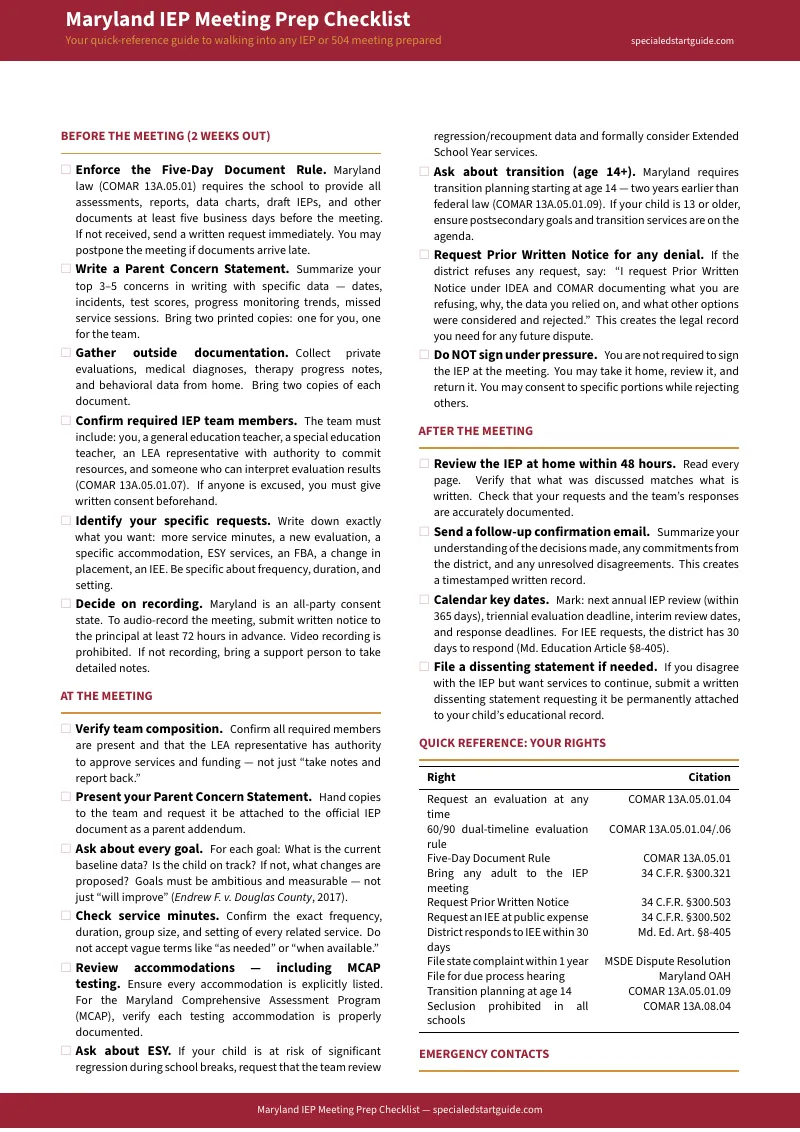
- Maryland IEP Meeting Prep Checklist — quick-reference guide covering the Five-Day Document Rule, meeting preparation, at-the-meeting scripts, post-meeting follow-up steps, and key COMAR citations
- Advocacy Letter Templates — fill-in-the-blank letters citing exact COMAR 13A.05.01 regulations for IEE demands, Prior Written Notice requests, Five-Day Document Rule enforcement, service non-delivery documentation, and formal disagreements
- MSDE State Complaint Template — structured complaint filing template with required elements, evidence attachment guide, and the one-year filing deadline
- Communication Log — printable documentation tracker for every call, meeting, and conversation — the systematic paper trail that wins cases
- MDR Preparation Checklist — step-by-step Manifestation Determination Review preparation including the two legal questions, FBA demand templates, and BIP review protocol
- Dispute Escalation Ladder — visual roadmap from informal advocacy through MSDE state complaint, mediation, OAH due process, and OCR complaint — with Maryland-specific timelines at every stage
- Meeting Recording Notice Template — the exact 72-hour written notice required to legally audio-record an IEP meeting under Maryland's all-party consent law
Instant PDF download. Print the dispute letter that matches your situation tonight. Send it tomorrow morning.
Money-back guarantee, no time limit. If the Playbook doesn't change how you handle disputes with your Maryland school district, email us for a full refund. No questions asked.
Not ready for the full Playbook? Download the free Maryland Dispute Letter Starter Kit — a printable quick-reference guide covering paper trail setup, the Five-Day Document Rule, core procedural rights, evaluation challenges, discipline protections, and escalation steps with key COMAR citations. It's enough to start building your case tonight, and it's free.
Your child's education is a legal right — and when the district violates it, Maryland law gives you the tools to fight back. This Playbook puts those tools in your hands.