
Your Child's School District Broke the Law. Here's the Paper Trail That Proves It.
You already know something is wrong. The IEP says 30 minutes of speech therapy three times a week, but the therapist position has been vacant since September and the SAU hasn't replaced her. The district evaluated your child and declared them ineligible — even though the evaluation felt rushed and the conclusions don't match the child you raise. You asked for an Independent Educational Evaluation and they said no. You pushed back at the IEP meeting and the Special Education Director overruled you, citing "team consensus." Your child was restrained at school and nobody called you until the end of the day. The Written Notice arrived on a Friday and you have seven days to respond before the changes take effect — and you don't know what to do.
You are not imagining this. Maine serves 34,951 students in special education — 20.4% of the total student population, one of the highest rates in the country. The federal Office of Special Education Programs determined that Maine "needs assistance" implementing IDEA. Maine schools report over 12,000 physical restraint and seclusion incidents every year, with 86% inflicted on students receiving special education services. In rural counties — Aroostook, Washington, Somerset, Oxford — there are virtually no special education attorneys, and the few statewide experts charge $150 to $300 per hour. In Portland, Bangor, and Lewiston, well-staffed districts still present pre-written IEPs and pressure parents to sign at the table. And across the state, SAUs with a single person serving as Superintendent, Special Ed Director, and building principal create a unified bureaucratic wall that parents cannot break through alone.
If you earn too much for Disability Rights Maine's caseload and not nearly enough for a private attorney, you are on your own — unless you know exactly how to build the case yourself.
The Maine IEP & 504 Advocacy Playbook is the MUSER Compliance System — the tactical toolkit that turns overwhelmed parents into effective advocates by providing the exact dispute letters, escalation procedures, and paper trail protocols grounded in Maine's MUSER Chapter 101, Chapter 33 restraint laws, and federal IDEA that force SAUs to respond on the record.
What's Inside the Playbook
The Fill-in-the-Blank Dispute Letter Library
Every letter cites the exact MUSER regulation. Demand an Independent Educational Evaluation at public expense — using the specific legal obligation under MUSER Section V that requires the SAU to either fund the IEE or file for due process to defend their own evaluation. Request Prior Written Notice for every denial — because the SAU is required under MUSER to explain in writing what they refused, why, what data they relied on, and what alternatives they considered. Document service non-delivery with the specific timeline citations that prove the SAU violated the IEP. Challenge an evaluation you disagree with. Request a Functional Behavioral Assessment. Demand Chapter 33 restraint incident reports. These aren't generic federal templates — they cite the MUSER Chapter 101 sections that Maine DOE compliance investigators check during state complaint investigations.
The Paper Trail System
In Maine special education disputes, the governing axiom is: if it is not in the Written Notice, it did not happen. Without a documented paper trail, you lose. The Playbook includes communication logs, Letters of Understanding templates for every verbal conversation, and a systematic documentation protocol that builds the evidence Maine hearing officers require. Every phone call gets a summary email within 24 hours. Every meeting gets a written follow-up. Every denial triggers a Prior Written Notice demand. This is the foundation that wins cases — or prevents them from being necessary, because SAUs respond differently when they know the parent is documenting everything.
The 7-Day PWN Playbook
Under MUSER, changes to an IEP cannot take effect until at least 7 days after the parent receives the Prior Written Notice. This narrow window is the most critical period in Maine special education advocacy. Filing for mediation or due process during this window triggers Stay Put protections, freezing your child's current placement and services during the entire dispute. National guides do not cover this Maine-specific timeline. The Playbook walks you through recognizing a PWN, calculating your deadline, and filing the request that freezes everything in place before the SAU can implement an unwanted change.
The Chapter 33 Restraint and Seclusion Protocol
Maine schools report over 12,000 restraint and seclusion incidents annually — 86% involving students with disabilities. Despite LD 1373 and the 2025 updates under LD 1248 restricting these practices to "imminent danger" scenarios, schools continue using physical restraint, seclusion rooms, and newly defined "blocks and deflections." Under 20-A MRSA §4014, the school must notify you the same day. The Playbook gives you the exact demand letter for Chapter 33 incident reports, explains when restraint is illegal under current Maine law, and walks you through filing a state complaint when the school fails to document or report.
The CDS Transition Survival Guide
Maine's Child Development Services manages special education from birth to age 5. When your child transitions to the local SAU for kindergarten, the receiving district frequently attempts to strip away the intensive therapies CDS provided. Due process records show CDS itself sometimes fails to deliver required OT and PT due to provider shortages, leaving families stranded. The Playbook covers the mandatory spring transition meetings, how to prevent the SAU from reducing services during the handoff, and how to demand compensatory education when CDS or the SAU fails to provide what the IEP requires.
The State Complaint Filing Guide
A Maine DOE State Complaint is free, does not require an attorney, and frequently produces faster results than due process. You submit it to the Maine Department of Education, 23 State House Station, Augusta, ME 04333. The DOE has 60 calendar days to investigate and issue a decision. The Playbook explains which violations are best suited for state complaints versus mediation versus due process, how to frame the complaint for maximum impact, what evidence to attach, and the common mistakes that result in dismissed complaints.
The Due Process Hearing Roadmap
Due process is the highest administrative remedy before federal court. The statute of limitations is two years. The SAU must respond within 10 days, and a resolution meeting must occur within 15 days. Your child stays in their current placement during the entire process — the Stay Put provision. The Playbook covers resolution session strategy, evidence organization, what hearing officers look for, and how to build a case that survives without spending tens of thousands on an attorney.
The Rural District Advocacy Playbook
When your SAU claims they "don't have the resources" to implement the IEP — no speech pathologist on staff, no behavioral specialist in the county, no funding for out-of-district placement — the law is absolute: FAPE cannot be denied because of administrative convenience, geographic isolation, or local financial constraints. MUSER requires the SAU to locate and fund an appropriate placement, even if that means an out-of-district Special Purpose Private School. The Playbook provides the specific written demands that force the SAU to document their refusal, triggering your right to escalate.
Who This Playbook Is For
- Parents whose child was denied special education eligibility despite clear academic, behavioral, or functional struggles — and who need to challenge the evaluation or request an IEE at public expense
- Parents whose child's IEP services are not being delivered — the therapist position is vacant, the aide covers multiple classrooms, the goals haven't changed in two years — and who need to create the paper trail that forces the SAU to act
- Parents facing disciplinary action against their child — suspensions, alternative placements, restraint or seclusion incidents — who need to understand Manifestation Determination Reviews and protect their child's right to Stay Put
- Parents in rural Maine counties where the SAU genuinely lacks staff to deliver IEP services — and who need to know how to demand compensatory education, private provider reimbursement, or tele-therapy accommodations
- Parents in Portland, Bangor, Lewiston, or Scarborough dealing with districts that pressure families to accept proposals without adequate time to review
- Parents navigating the CDS-to-kindergarten transition who are watching the receiving SAU strip away early intervention therapies
- Parents whose child has been physically restrained or secluded at school and who need to demand Chapter 33 documentation and file complaints under current Maine law
Why Not Just Use the Free Resources?
Maine has serious free advocacy resources. The Maine Parent Federation provides parent training and Family Support Navigators. Disability Rights Maine publishes legal handbooks and litigates systemic violations. The Maine DOE publishes MUSER regulations and procedural safeguard manuals. Here's why parents still lose disputes after consulting all of them:
- The Maine Parent Federation educates — it does not litigate. MPF provides excellent foundational training on your rights and connects you with peer navigators. But their capacity for individualized, aggressive legal strategy is constrained by their federal funding mandate. When you need a fill-in-the-blank dispute letter citing MUSER Section V to demand an IEE at public expense tonight, MPF cannot provide that. Their waitlist for one-on-one support may not align with your 7-day PWN deadline.
- Disability Rights Maine triages the most severe cases. DRM is the state's federally mandated protection and advocacy agency. They investigate civil rights violations and litigate systemic failures. They cannot represent every parent who disagrees with an IEP goal or faces a quiet erosion of services. If your case is not extreme enough for their caseload, you are on your own.
- MUSER is 160+ pages of regulatory code. The Maine DOE publishes the regulations, but the document is written by the bureaucracy, for the bureaucracy. It is entirely inaccessible to a parent without legal training. It tells you what the rules are — it does not give you the fill-in-the-blank letter that forces the SAU to follow them.
- Wrightslaw covers federal IDEA — not Maine's MUSER. Wrightslaw is the gold standard for federal special education law. It does not address Maine's 7-day PWN window, Chapter 33 restraint protocols, the CDS transition, or how Maine hearing officers interpret burden of proof. Federal citations are useful; MUSER citations tell the SAU you know their playbook.
- Private advocates cost $100–$200 per hour. Special education attorneys charge $150–$300. Most Maine families cannot afford this — and advocates achieve better results when the parent arrives with an organized paper trail. This Playbook is how you build that trail.
The free resources explain what Maine law says. This Playbook gives you the dispute tools to make the SAU comply.
— Less Than One Hour of a Special Education Advocate
Private advocates in Maine charge $100–$200 per hour. Educational attorneys run $150–$300. A single consultation to review your situation costs more than this entire Playbook. The Playbook gives you the dispute letters, escalation procedures, and documentation system that advocates use — so you can either handle the dispute yourself or arrive at a paid consultation with an organized case file that saves hundreds in billable hours.
Your download includes the complete Advocacy Playbook guide plus standalone printable PDFs — every dispute letter template, escalation checklist, and reference card, ready to print and use tonight.
- Complete Advocacy Playbook Guide — 16 chapters covering the Maine special education landscape, building your advocacy binder, MUSER decoded, evaluations and fighting denials, measurable IEP goals, Chapter 33 seclusion and restraint protections, the CDS transition, discipline protections and Manifestation Determinations, Section 504 plans, ESY and compensatory services, transition planning to adulthood, dispute resolution, rural district advocacy, parentally placed private school students, moving between districts, and recording and protecting your record
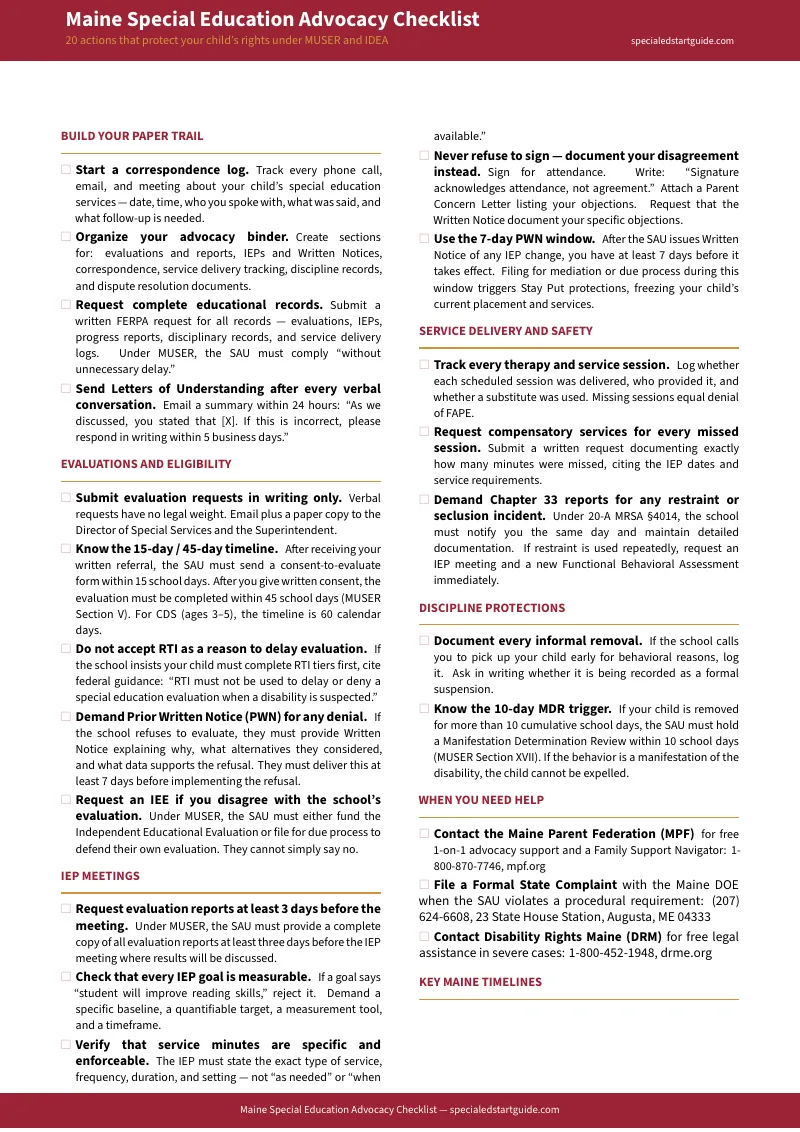
- Maine Dispute Letter Starter Kit — the quick-reference checklist covering paper trail setup, core procedural rights, evaluation challenges, discipline protections, and escalation procedures with key MUSER timelines
- Advocacy Letter Templates — fill-in-the-blank letters citing exact MUSER Chapter 101 regulations for IEE demands, Prior Written Notice requests, service non-delivery documentation, and formal disagreements
- State Complaint Template — structured Maine DOE complaint filing template with required elements, evidence attachment guide, and mailing instructions
- Communication Log — printable documentation tracker for every call, meeting, and conversation — the systematic paper trail that wins cases
- MDR Preparation Checklist — step-by-step Manifestation Determination Review preparation including the two legal questions, FBA demand templates, and BIP review protocol
- Dispute Escalation Ladder — visual roadmap from informal advocacy through state complaint, mediation, due process, and OCR complaint — with Maine-specific timelines at every stage
- Chapter 33 Incident Demand Letter — pre-written formal demand for restraint and seclusion documentation under 20-A MRSA §4014, citing current Maine law
Instant PDF download. Print the dispute letter that matches your situation tonight. Send it tomorrow morning.
Money-back guarantee, no time limit. If the Playbook doesn't change how you handle disputes with your Maine school district, email us for a full refund. No questions asked.
Not ready for the full Playbook? Download the free Maine Dispute Letter Starter Kit — a printable quick-reference guide covering paper trail setup, core procedural rights, evaluation challenges, discipline protections, and escalation steps with key MUSER timelines and Chapter 101 citations. It's enough to start building your case tonight, and it's free.
Your child's education is a legal right — and when the SAU violates it, Maine law gives you the tools to fight back. This Playbook puts those tools in your hands.