
The District Knows Georgia SBOE Rules. Now You Will Too.
You walked into that IEP meeting prepared — or you thought you did. You read the GaDOE Procedural Safeguards notice. You printed the evaluations. You wrote down your concerns. And then the team smiled, used acronyms you'd never heard before, and told you your child "doesn't qualify" or that certain services "aren't available at this school."
You left the meeting with the same IEP your child walked in with. No additional minutes. No new assessments. No Prior Written Notice explaining why they refused your requests — because you didn't know to ask for one.
The problem isn't that you're uninformed. The problem is that Georgia's special education system is specifically designed to be navigated by professionals, not parents. A hundred and eighty school districts across 159 counties, each with different unwritten rules. A Student Support Team process that delays evaluations for months — even though Georgia law allows parents to bypass it entirely. A state that publishes dense administrative code but zero fill-in-the-blank templates. And free resources like Parent Mentors whose paychecks are signed by the same district you're trying to fight.
The Georgia IEP & 504 Advocacy Playbook is the tactical dispute toolkit that bridges the gap between knowing your rights and actually enforcing them — with every template, script, and checklist grounded in the Georgia State Board of Education Rules and O.C.G.A. citations.
What's Inside the Playbook
The SST Bypass Strategy
Georgia schools routinely funnel struggling students into the Student Support Team (SST) process under the Multi-Tiered System of Supports framework — and it can drag on for months without producing an IEP evaluation. What most parents don't know: Rule 160-4-2-.32(3)(a) explicitly allows parents to bypass the SST process entirely when the need for special education services is clear. The Playbook gives you the exact email script to invoke this bypass, the legal citation that forces the district to respond, and the follow-up sequence that keeps the 60-calendar-day evaluation clock ticking from day one.
The Copy-Paste Dispute Letter Library
Every letter cites the exact Georgia rule. Request a special education evaluation under Rule 160-4-7-.04 and start the district's 60-calendar-day clock. Demand an Independent Educational Evaluation at public expense when the district's assessment misses your child's needs. File a formal state complaint with GaDOE when the district violates the IEP. Request Prior Written Notice under Rule 160-4-7-.09 when the team refuses anything. These aren't generic samples — they're Georgia-specific enforcement tools that create a legally binding paper trail the moment you hit send.
The GNETS Defense Guide
The Georgia Network for Educational and Therapeutic Support has been the subject of a Department of Justice lawsuit alleging illegal segregation and ADA violations. The mere suggestion of a GNETS placement should trigger immediate advocacy. The Playbook walks you through how to refuse a GNETS placement, demand a Free Appropriate Public Education in the Least Restrictive Environment, document the district's failure to provide adequate behavioral supports in the general education setting, and leverage the DOJ findings as evidence that GNETS is not an appropriate placement for your child.
The GaDOE Complaint and OSAH Due Process Guide
When mediation fails and the district won't comply, the Playbook walks you through every formal option. File a state complaint with the Georgia Department of Education — which triggers a state investigation within 60 days and costs you nothing. Or file for a due process hearing through the Office of State Administrative Hearings (OSAH). The Playbook covers filing requirements, evidence preparation, the resolution session process, and what the Administrative Law Judge can order — so whether you file pro se or hire an attorney later, you arrive with an organized case file that saves thousands in billable hours.
The SB 10 Special Needs Scholarship Decision Framework
Georgia's Special Needs Scholarship (Senate Bill 10) lets families of eligible students with disabilities transfer to a participating private school with state-funded tuition. But leaving the public system means losing IDEA protections — no more legally binding IEP, no due process rights, no compensatory education claims. The Playbook provides a strategic decision tree: how to evaluate whether your child's needs are being met in the public setting, what you lose when you leave, what you gain, and how to ensure your documentation is ironclad before making the switch.
IEP Meeting Scripts and Checklists
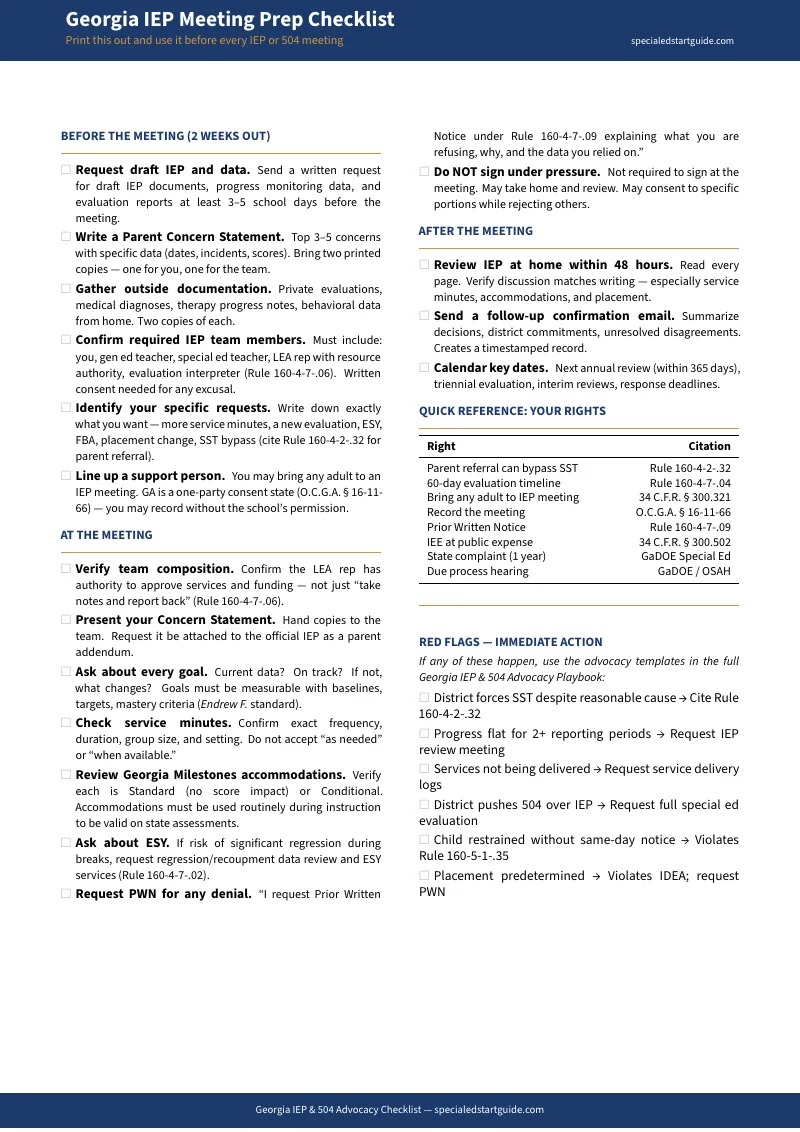
What to say when the team tells you your child is "doing fine" but melts down every night at home. What to say when they offer a 504 instead of an IEP. What to say when the administrator claims they don't have funding for a requested service. Each script cites the Georgia SBOE Rule or O.C.G.A. section that proves them wrong — so you're not arguing opinions, you're citing law. The pre-meeting checklist covers team composition verification under Rule 160-4-7-.06, document requests, and the specific items to bring.
Restraint, Seclusion & Discipline Protections
When your child is physically restrained, placed in seclusion, or suspended for behavior that is a manifestation of their disability, you need to act immediately. The Playbook covers restraint and seclusion reporting requirements under Georgia law, the manifestation determination process, FBA and BIP demand sequences, and the specific protections that prevent districts from disciplining children for disability-related behaviors.
Goal-Tracking and Documentation Worksheets
IEP goals are legally required to be measurable — with baselines, targets, and mastery criteria that meet the Endrew F. standard. But many goals are written so vaguely that progress is impossible to track. The worksheets give you a structured format to log data between meetings, compare school-reported progress against your own observations, and arrive at the annual review with documentation that either confirms the program is working or proves it isn't.
Who This Playbook Is For
- Parents whose child has been stuck in the SST process for months without an IEP evaluation — and who need the legal language to bypass it under Rule 160-4-2-.32 and force the district's hand
- Parents whose child's IEP team is proposing a GNETS placement — and who need the advocacy strategy to refuse it and demand services in the Least Restrictive Environment
- Parents whose child has been subjected to restraint, seclusion, or repeated suspensions for disability-related behavior — and who need immediate procedural protections
- Parents in Metro Atlanta districts (Fulton, DeKalb, Cobb, Gwinnett) where massive bureaucracies create systemic rigidity and high volumes of formal complaints
- Parents in rural Georgia districts where no private school alternatives exist, no independent evaluators are nearby, and the local public school is the only option — making effective internal advocacy even more critical
- Parents who've been told their child is "too high-functioning" for services despite clinical diagnoses — and who need the statutes that prove educational impact, not academic grades, is the standard
- Parents weighing the SB 10 Special Needs Scholarship who need to understand what they lose when they leave the public system
- Parents preparing for a due process hearing or GaDOE state complaint who want to build their case file before hiring an attorney
Why Not Just Use the Free Resources?
Georgia has state-funded support systems for special education parents. Parent Mentors serve 90 districts. Parent to Parent of Georgia offers a 7,000-entry resource database. The Georgia Advocacy Office handles systemic cases. Here's why parents still struggle after consulting all of them:
- Parent Mentors are hired by the school district. Georgia's Parent Mentor Partnership places parents of children with disabilities inside school systems as mentors — and their mandate is to "enhance communication" between families and districts. They cannot aggressively advocate against the district that signs their paycheck. When you need to file a state complaint or demand an IEE at public expense, a Parent Mentor isn't allowed to help. The Playbook is independent — it works for you, not the district.
- Parent to Parent of Georgia provides information, not execution tools. P2P's helpline and resource database are a solid starting point for general overviews. But they provide fact sheets on IDEA, not fill-in-the-blank legal demand letters that cite Georgia SBOE rules. If you want a 7,000-item directory, call P2P. If you want an exact script to email the Special Ed Director tonight, get the Playbook.
- The Georgia Advocacy Office reserves resources for severe cases. The GAO is the independent Protection and Advocacy system for Georgia, and they have teeth — they're involved in high-level systemic lawsuits including the DOJ case against GNETS. But their limited resources are reserved for cases of abuse, neglect, and systemic segregation. They are not available to help the average parent negotiate a dyslexia reading goal or get an extra 30 minutes of speech therapy.
- The GaDOE publishes rules, not roadmaps. Georgia's State Board of Education Rules (the 160-4-7 series) are the legal authority. They're also dense, legalistic, and nearly impossible for a parent in crisis to decode at 10 PM before tomorrow's meeting. The Playbook translates every relevant rule into plain English with a ready-to-send template attached.
The free resources explain what the law says. The Playbook gives you the tools to make the district follow it.
— Less Than 5 Minutes of a Georgia Special Ed Advocate
Special education advocates in Georgia charge $100–$300 per hour. A special education attorney runs $300–$500 per hour. Even if you eventually need professional help, the meticulous paper trail you build with this Playbook saves thousands in billable hours — because you're handing your advocate an organized case, not a shoebox of unsigned IEP copies and half-remembered conversations.
Your download includes the complete Advocacy Playbook guide plus standalone printable PDFs — every template, worksheet, script, and reference card, ready to print and bring to your next meeting.
- Complete Advocacy Playbook Guide — 17 chapters covering the SST bypass strategy, evaluations, IEP development, 504 plans, GNETS defense, SB 10 scholarship decisions, dispute resolution, restraint/seclusion protections, Georgia Milestones accommodations, transition planning, and district-specific advocacy intelligence
- IEP Meeting Prep Checklist — the before/during/after checklist with Georgia-specific timelines and SBOE rule citations for every step
- Advocacy Letter Templates — copy-paste dispute letters citing exact Georgia SBOE Rules and O.C.G.A. sections for evaluations, SST bypass, IEEs, PWN demands, FBA requests, GaDOE state complaints, and OSAH due process filings
- Goal-Tracking Worksheet — structured fillable worksheet for measurable progress monitoring between annual reviews
- Georgia Timeline Cheat Sheet — every legal deadline on one page: 60-calendar-day evaluation, annual reviews, triennial evaluations, complaint filing windows, and OSAH due process deadlines
- IEP Meeting Scripts — word-for-word responses to common district pushback tactics, each citing the specific Georgia SBOE Rule or O.C.G.A. section
- GNETS Defense Reference Card — the DOJ findings, your rights to refuse segregated placement, and the LRE demand sequence on one printable page
- Dispute Resolution Roadmap — your formal options when advocacy fails: GaDOE state complaint, mediation, and OSAH due process — with a comparison table
Instant PDF download. Print the templates tonight. Walk into tomorrow's meeting with Georgia law on your side.
Money-back guarantee, no time limit. If the Playbook doesn't change how you approach special education disputes in Georgia, email us for a full refund. No questions asked.
Not ready for the full Playbook? Download the free Georgia Dispute Letter Starter Kit — a sample dispute letter template and parent rights one-pager for special education disagreements in Georgia. It's enough to send your first legally grounded email, and it's free.
Your child's education is a legal right, not a favor. The district knows Georgia SBOE rules. After tonight, so will you.