
When the District Says No, You Need More Than Knowledge — You Need a Dispute Strategy
You've already been through the meetings. You already know the PPT format, the 45-school-day timeline, the jargon. Maybe you've even sent a few advocacy letters. But the district said no — denied services, refused an outplacement, downgraded a classification, or simply ignored your written requests. And now you're staring at the same IEP your child has had for two years, wondering whether the only option left is a $5,000 attorney retainer.
It isn't. But what comes next requires more than templates — it requires a dispute strategy built specifically for Connecticut law.
The Connecticut IEP & 504 Advocacy Playbook is the tactical escalation toolkit for parents who have already tried asking nicely. Every complaint template, due process preparation guide, and outplacement strategy is grounded in Connecticut General Statutes, RCSA regulations, and CSDE guidance — because when you're filing a formal complaint with the Bureau of Special Education, citing "IDEA Section 300.503" isn't enough. You need to cite C.G.S. §10-76h and RCSA §10-76h-4, and you need to know exactly what the BSE investigator will be looking for.
What's Inside the Advocacy Playbook
The State Complaint Construction Kit
Filing a state complaint with the CSDE Bureau of Special Education is the most powerful enforcement tool available to Connecticut parents — the BSE must investigate and issue a corrective action within 60 calendar days. But complaints succeed or fail based on how they're written. The Playbook provides the complete complaint template with pre-loaded Connecticut statute citations, teaches you how to structure the violation narrative so the investigator can verify each claim against district records, and explains exactly what corrective actions are available — from compensatory education to systemic policy changes. Most parents don't know they can file a state complaint at all. The ones who do rarely know how to write one that forces action.
The Due Process Preparation System
A due process hearing in Connecticut is a legal proceeding before a hearing officer appointed by the BSE. Families who walk in without organized evidence and a clear theory of violation lose — and the 2-year statute of limitations means you can't come back later with a better case. The Playbook breaks down the five-resolution-meeting framework, explains the discovery process, teaches you how to organize your evidence chronologically by violation, and provides the opening statement structure. It won't replace an attorney in the hearing room, but it transforms you from someone who needs a lawyer to explain the process into someone who hands their lawyer an organized case — saving thousands in billable hours.
The Outplacement Escalation Strategy
Connecticut places 6.2% of students with IEPs in out-of-district facilities — more than 2.5 times the national average. If the district is denying an Approved Private Special Education Program (APSEP) placement, the Playbook maps the legal requirements for a unilateral placement under 20 U.S.C. §1412(a)(10)(C): the mandatory 10-business-day written notice before removing your child, the evidence standard for proving the district cannot provide FAPE, and the tuition reimbursement process. One missed procedural step — especially failing to provide written notice — can forfeit your entire reimbursement claim. The template ensures you don't make that mistake.
The Compensatory Education Demand Framework
When a district violates its obligations under Connecticut law — missed evaluation timelines, failure to implement IEP services, denial of FAPE — your child is owed compensatory education. Not a vague promise to "make up" missed services, but a quantified remedy calculated hour-for-hour against documented violations. The Playbook provides the demand letter template, explains how to calculate compensatory hours using district progress reports and service logs, and walks you through the escalation path when the district refuses.
The Mediation Preparation Guide
BSE-facilitated mediation is voluntary, confidential, and — when prepared properly — the fastest path to resolution without a hearing. But mediation favors the prepared party. The Playbook teaches you how to write a mediation position statement, what documentation to bring, how to structure your opening proposal, and what concessions are reasonable versus which ones undermine your child's legal entitlement. Districts bring experienced counsel to mediation. The Playbook ensures you walk in with the same level of preparation.
The PPT Escalation Scripts
Before you file a complaint or request a hearing, the Playbook arms you with escalation language for the PPT table itself — what to say when the district denies services without Prior Written Notice, when they refuse to convene a PPT within the timelines required by RCSA §10-76d-13, when they attempt to reduce services without data, or when they claim staffing shortages excuse noncompliance. Each script cites the exact Connecticut statute that proves the district wrong.
The Documentation Standards Guide
Every dispute outcome depends on your paper trail. The Playbook establishes the documentation system: what to save, how to organize it, how to create contemporaneous written records of verbal conversations, and how to use the CT-SEDS Parent Portal to track IEP amendments and verify service delivery. When you eventually file a complaint or walk into a hearing, the strength of your case is the strength of your records.
Who This Playbook Is For
- Parents who have already tried informal advocacy — sent letters, attended PPT meetings, requested evaluations — and the district still isn't providing what their child needs
- Parents considering filing a state complaint with the BSE but unsure how to write one that triggers real corrective action
- Parents whose district denied an outplacement to an APSEP and who need to understand the unilateral placement process before they lose the 10-business-day notice window
- Parents in Alliance Districts — Bridgeport, Hartford, New Haven, Waterbury — where chronic underfunding and staffing shortages create systemic FAPE violations that require formal enforcement, not just better meeting skills
- Parents in affluent Fairfield County districts — Greenwich, Westport, Fairfield — where the district retains corporate law firms to deny expensive services and outplacements
- Parents whose child lost services due to district noncompliance and who need to demand compensatory education with a quantified, documented claim
- Parents preparing for mediation or due process who need to organize their evidence and understand the process before engaging an attorney
Why This Isn't Covered by Free Resources
Connecticut's free advocacy infrastructure — CPAC, Disability Rights Connecticut, the CSDE's Parent's Guide — is built around collaboration and education. Those organizations do important work. But they are structurally designed to explain the system, not to arm you for a fight within it.
- CPAC teaches you the process — not how to escalate when it fails. CPAC is the state's federally funded Parent Training and Information Center. They provide outstanding workshops and phone consultations. But CPAC's mandate is collaborative empowerment: they teach parents to participate in the system, not to file formal complaints when the system fails them. They do not provide complaint templates, due process preparation, or mediation strategy.
- The state's procedural safeguards notice is a compliance document, not an enforcement manual. The 35-page Procedural Safeguards notice explains that you have the right to file a state complaint or request a hearing. It does not tell you how to structure the complaint narrative, what evidence to attach, or what corrective actions are available. It was written for federal compliance — not for a parent who needs to use these rights tonight.
- Disability Rights Connecticut fights systemic battles. DRCT is a powerhouse in civil rights litigation — their investigation into out-of-state APSEP placements forced statewide reform. But DRCT cannot represent individual families in PPT disputes. Their resources are legal manuals written for attorneys and systemic advocates, not tactical tools for a parent preparing for mediation next week.
- Generic dispute letter templates cite federal law — not Connecticut statutes. A state complaint to the CSDE Bureau of Special Education must cite Connecticut General Statutes and RCSA regulations, not just IDEA sections. Nationally published templates send you into a Connecticut enforcement proceeding quoting the wrong law.
The free resources explain what your rights are. The Advocacy Playbook gives you the tools to enforce them when the district says no.
— Less Than 6 Minutes of a Special Education Attorney
Special education attorneys in Connecticut charge $250–$500 per hour and routinely require retainers of $3,000–$7,500. A single mediation can cost $10,000. A due process hearing easily exceeds $50,000 in legal fees. For many families — especially those in Alliance Districts — hiring an attorney isn't an option at all.
The Advocacy Playbook doesn't replace an attorney. But it does two things that save families thousands: it gives you the tools to resolve many disputes without legal representation, and when you do need a lawyer, you hand them an organized, documented case instead of a folder of unsigned IEP copies — cutting weeks of billable preparation time.
Your download includes the complete Advocacy Playbook guide plus 7 standalone printable PDFs:
- Complete Advocacy Playbook Guide (guide.pdf) — 16 chapters covering the Connecticut advocacy landscape, your legal arsenal of CGS and RCSA citations, PPT structure and strategy, evaluation enforcement, PPT meeting tactics, fill-in-the-blank advocacy letter templates, dispute resolution (state complaints, mediation, and due process), outplacement strategy, discipline protections and manifestation determinations, bullying protections, special populations, ESY services, transition planning, recent legislative reforms, documentation standards, and the Connecticut resources directory
- Advocacy Letter Templates (advocacy-letters.pdf) — 7 fill-in-the-blank letters citing CGS §10-76 and federal IDEA: evaluation request, Prior Written Notice demand, IEE request, PPT recording notice, educational records request, state complaint narrative, and 10-day unilateral placement notice
- CSDE State Complaint Template (state-complaint-template.pdf) — Complete complaint narrative structure for the Bureau of Special Education, with common violation categories and filing tips
- Dispute Escalation Ladder (escalation-ladder.pdf) — Visual quick-reference: documentation → PWN demand → state complaint → mediation → due process, with Connecticut-specific timelines at every stage
- Communication Log (communication-log.pdf) — Printable interaction tracker for building the paper trail that wins complaints, mediation, and hearings
- MDR Preparation Checklist (mdr-prep-checklist.pdf) — Manifestation Determination Review prep: the two legal questions, evidence to bring, key arguments, and outcome flowchart
- Outplacement Checklist (outplacement-checklist.pdf) — APSEP placement process from building the failure-based case through the 10-day notice to monitoring the placement
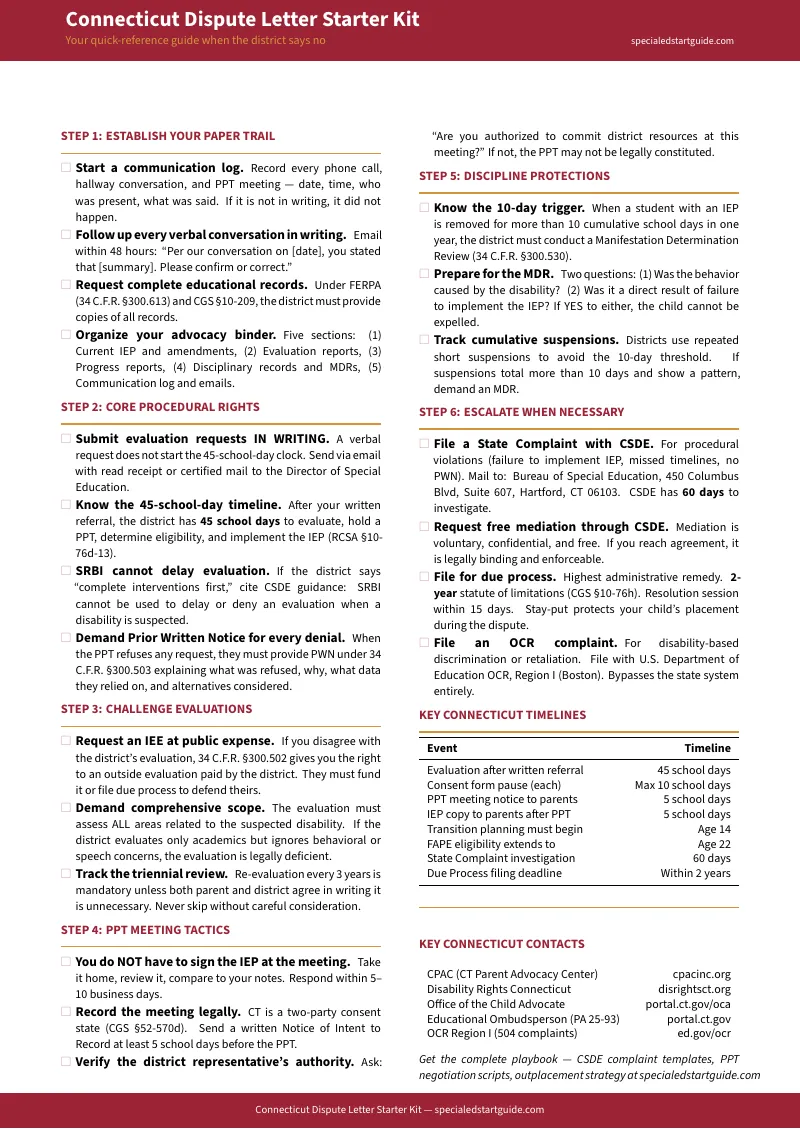
- Dispute Letter Starter Kit (checklist.pdf) — 3 ready-to-send templates (evaluation request, Prior Written Notice demand, IEE request) plus a Parent Rights One-Pager with Connecticut-specific deadlines and statute citations
Instant PDF download. Print the templates tonight. File the complaint tomorrow.
Money-back guarantee, no time limit. If the Playbook doesn't give you a clear path forward in your Connecticut special education dispute, email us for a full refund. No questions asked.
Not ready for the full Playbook? Download the free Connecticut Dispute Letter Starter Kit — sample dispute letter templates and a parent rights one-pager for Connecticut special education disagreements. It's enough to send your first formal letter, and it's free.
The district has a legal team. After tonight, you'll have a strategy.