
The School Said "We Don't Have the Resources." Arizona Law Says That's Illegal.
Your charter school principal smiled through the IEP meeting, agreed your child needs services, then explained that the school "doesn't have a resource room" and suggested your neighborhood district might be "a better fit." The district school, meanwhile, is pushing you toward an Empowerment Scholarship Account — $30,000 in public funds that sounds like freedom until you read the contract and realize you're signing away your child's right to FAPE, due process, disciplinary protections, and every IEP safeguard under IDEA. You know something is wrong with both options. You don't know the exact statute that proves it.
Arizona is the most aggressive school choice laboratory in the country — 550+ charter schools, universal ESAs, and a special education system that serves 143,000 students across a landscape where no one is telling parents the full truth. Charter schools are illegally "counseling out" children with disabilities. School choice advocates are promoting ESAs without disclosing the catastrophic loss of IDEA protections. State-funded parent organizations provide excellent support but cannot take an adversarial posture against districts. And private special education advocates charge $150 to $300 per hour for the same knowledge contained in the templates you could print tonight.
The Arizona IEP & 504 Advocacy Playbook is the Dispute Escalation System — the tactical manual that bridges the gap between knowing you have rights under Arizona law and actually forcing the school to comply, with every template, letter, and decision framework grounded in A.A.C. R7-2-401, A.R.S. Title 15, and IDEA.
What's Inside the Playbook
The ESA vs. IEP Decision Framework
This is the tool no free resource in Arizona provides. Before you sign an Empowerment Scholarship Account contract, this framework forces the financial and legal calculation most parents never make. List every service on your child's current IEP — speech therapy, OT, paraprofessional support, behavioral intervention, specialized transportation. Calculate the private market cost of replacing each one. Compare that total against the specific ESA dollar amount your child would receive based on their disability category. For many families, the ESA covers tuition but not the $50,000+ in related services your child is legally entitled to under IDEA — services the private school has zero obligation to provide. The framework also covers ClassWallet compliance rules, prohibited expenses, quarterly disbursement budgeting, and the step-by-step process for returning to the public system if the private placement fails.
The Charter School Defense Scripts
When a charter school administrator tells you they "can't accommodate" the IEP, they are breaking the law. Every Arizona charter school is an independent LEA under IDEA — carrying the exact same federal obligations as Mesa Unified or Tucson Unified. Under A.R.S. § 15-184(F), charter schools cannot deny enrollment based on disability. The Playbook provides pre-written email scripts that cite the specific Arizona statute and federal regulation for each common violation: refusing to implement related services, failing to conduct a Manifestation Determination Review before suspension, claiming the school "doesn't offer" a particular placement, and the illegal practice of counseling families out by suggesting the ESA as an alternative to fixing service delivery.
The ADE State Complaint Filing Guide
A State Complaint filed with ADE Exceptional Student Services is the most powerful and underused tool available to Arizona parents. It is free. It does not require an attorney. ADE must investigate and issue a decision within 60 days. The Playbook walks you through exactly what to include, how to structure the timeline of violations, what evidence to attach, and how to frame the complaint so ADE's investigators can act on it immediately. It also covers when a State Complaint is more effective than mediation, when due process is the better option, and how to build the paper trail that wins at each level.
The Copy-Paste Dispute Letter Library
Every letter cites the exact Arizona regulation. Demand Prior Written Notice when the school refuses your request — forcing them to explain their reasoning in writing under A.A.C. R7-2-401. Request an Independent Educational Evaluation at public expense using the specific legal phrase that triggers the district's obligation to either pay or file for due process. Demand compensatory education for documented service gaps. Formally disagree with an IEP proposal. Request a Functional Behavioral Assessment. Demand a Manifestation Determination Review. Each template creates a legally binding paper trail the moment you hit send.
The Dispute Resolution Escalation Ladder
When informal advocacy fails, Arizona offers formal options with strict timelines and specific procedures. The Playbook maps every level — from facilitated IEP meetings through ADE State Complaints (60-day investigation), mediation (voluntary, no cost to parents), and due process hearings before an Administrative Law Judge. Each level includes the filing procedures, what to expect, how to prepare, and the strategic considerations for choosing one path over another. The ladder also explains how to convert a failed mediation into a State Complaint without losing ground.
The Compensatory Education Calculator
If your child's school has been failing to deliver IEP services — missed speech sessions, absent paraprofessionals, therapy hours that never materialized — those minutes are owed. The calculator provides a structured method for documenting every missed service, calculating the deficit in minutes and hours, and drafting the compensatory education demand letter that forces the district to make it right. This is not a vague "talk to the district" suggestion — it is the exact tracking framework and demand language that private advocates use.
IEP Meeting Counter-Scripts
What to say when the team pushes a 504 instead of an IEP — and why Arizona's unfunded mandate structure makes that dangerous. What to say when they claim your child "doesn't qualify" because grades are passing. What to say when the charter school suggests the ESA as a solution to their own service delivery failures. What to say when someone proposes reducing speech therapy hours because "the child is making progress." Each script cites the A.A.C. R7-2-401 regulation that proves them wrong — so you're citing Arizona law at the table, not arguing opinions.
Bilingual Family Rights Supplement
If your family's primary language is Spanish — or any language other than English — this section covers your right to a competent interpreter at every IEP meeting, the requirement for translated Procedural Safeguards and Prior Written Notice, the Proposition 203 waiver process under A.R.S. § 15-753 for English Language Learners who need bilingual special education services, and how to ensure evaluations use culturally and linguistically appropriate instruments. Arizona has a critical shortage of bilingual school psychologists — the Playbook explains how to use that fact as leverage when the district delays evaluations.
Who This Playbook Is For
- Parents whose charter school is failing to implement the IEP — reducing services, avoiding evaluations, or pushing the family toward withdrawal — and who need the specific statutes to force compliance
- Parents being pressured to accept an Empowerment Scholarship Account who need to understand exactly what IDEA protections they would be waiving before signing the contract
- Parents who disagree with an IEP team decision and need to escalate — from formal disagreement letters to State Complaints to due process — without hiring a $300/hour advocate
- Parents whose child is accumulating missed IEP services and who need to document the deficit and demand compensatory education
- Bilingual and Spanish-speaking families navigating the intersection of language rights and disability rights in Arizona's post-Proposition 203 landscape
- Military families at Luke AFB, Davis-Monthan AFB, or Fort Huachuca whose children's IEPs are being delayed or ignored during interstate transfer
- Parents in Phoenix, Tucson, Mesa, Chandler, Gilbert, or Scottsdale facing districts where caseloads are crushing, evaluations are backlogged, and IEP teams pressure parents to sign at the table
- Parents in rural Arizona or tribal communities where provider shortages and transportation barriers create chronic service delivery gaps
- Parents whose child was told they're "too smart for special education" or "grades are too high" — and who need to understand that academic performance is not the legal standard under Endrew F.
Why Not Just Use the Free Resources?
Arizona has strong free special education organizations. Here's why parents still get stuck after consulting all of them:
- Encircle Families (formerly Raising Special Kids) is state-funded and must remain neutral. They provide excellent emotional support, peer mentoring, and foundational knowledge about the IEP process. They cannot draft adversarial letters, advise you to threaten a State Complaint, or help you build a compensatory education case against a district. When the school has already broken down communication, you need tools that escalate — not tools that collaborate.
- The Arizona Center for Disability Law (ACDL) is severely capacity-limited. They publish legally sound self-advocacy guides — but they turn away the vast majority of families who call for individual representation. Their materials are written in dense legal terminology designed for attorneys, not for a parent who received a confusing evaluation report on Friday and has an IEP meeting on Monday.
- ADE's Procedural Safeguards are written to protect the state, not the parent. The 40+ page notice is a liability document at a graduate reading level. The ESA Parent Handbook details how not to get audited for fraud — but it never asks whether you should accept the ESA in the first place. The Playbook translates these bureaucratic documents into actionable decision tools.
- National guides like Wrightslaw don't cover Arizona's unique landscape. They won't explain the ESA vs. FAPE trade-off, charter school compliance gaps, the Proposition 203 bilingual waiver, or Arizona's specific 60-calendar-day evaluation timeline under A.A.C. R7-2-401(E)(3). Federal law is the floor — Arizona-specific implementation is where parents get lost.
- Etsy and TPT planners organize paperwork — they don't enforce rights. A pastel IEP binder keeps documents in order. It won't explain why the charter school is legally wrong, how to calculate compensatory service debt, or how to file a State Complaint with ADE that actually gets investigated.
- Private advocates cost $150–$300 per hour. Attorneys run $300–$500. A comprehensive advocacy package — record review, meeting prep, dispute strategy — costs $1,000 to $2,500. The Playbook teaches you how to build the paper trail, draft the dispute letters, and navigate the escalation process — either handling it alone or saving hundreds in billable hours if you do hire someone.
The free resources explain what Arizona law says. The Playbook gives you the tools to make the school follow it.
— Less Than Five Minutes of a Special Education Attorney
Private advocates in Arizona charge $150–$300 per hour. Special education attorneys run $300–$500 per hour, with initial consultations costing $500. A comprehensive advocacy retainer starts at $20,000. The Playbook provides the same dispute letter frameworks, State Complaint filing guidance, compensatory education strategies, and ESA decision tools that professionals use — formatted for a parent who needs to act tonight, not next quarter.
Your download includes the complete Playbook guide plus 7 standalone printable tools:
- Complete Advocacy Playbook — 12 chapters covering the ESA vs. IEP decision framework, charter school compliance enforcement, ADE State Complaint filing, dispute resolution escalation (mediation and due process), compensatory education recovery, IEP meeting counter-scripts, the copy-paste dispute letter library, bilingual family rights, military family transfer protections, and Arizona advocacy resources
- Advocacy Letter Templates — 8 fill-in-the-blank letters citing A.A.C. R7-2-401, A.R.S. Title 15, and federal IDEA: evaluation request, IEE demand, PWN demand, charter school compliance, compensatory education, restraint/seclusion follow-up, military PCS transfer, and FERPA records request
- ADE State Complaint Template — Fill-in-the-blank complaint form with sections for allegations, supporting facts, requested remedies, and attached documentation — ready to file with ADE Exceptional Student Services
- ESA vs. IEP Decision Framework — Printable worksheet to calculate what you gain vs. what you lose before signing an Empowerment Scholarship Account contract, including the service cost gap analysis and ClassWallet compliance checklist
- Dispute Escalation Ladder — One-page visual reference showing every step from documentation through PWN demands, facilitated IEP, State Complaint, mediation, due process, and OCR — with Arizona-specific timelines and contacts at each level
- Communication & Service Tracking Log — Printable log for documenting every interaction with the school plus a service delivery tracker for calculating compensatory education deficits
- MDR Preparation Checklist — Step-by-step checklist for Manifestation Determination Reviews: what to gather before, what to say during, and what to demand after — whether the behavior is found to be a manifestation or not
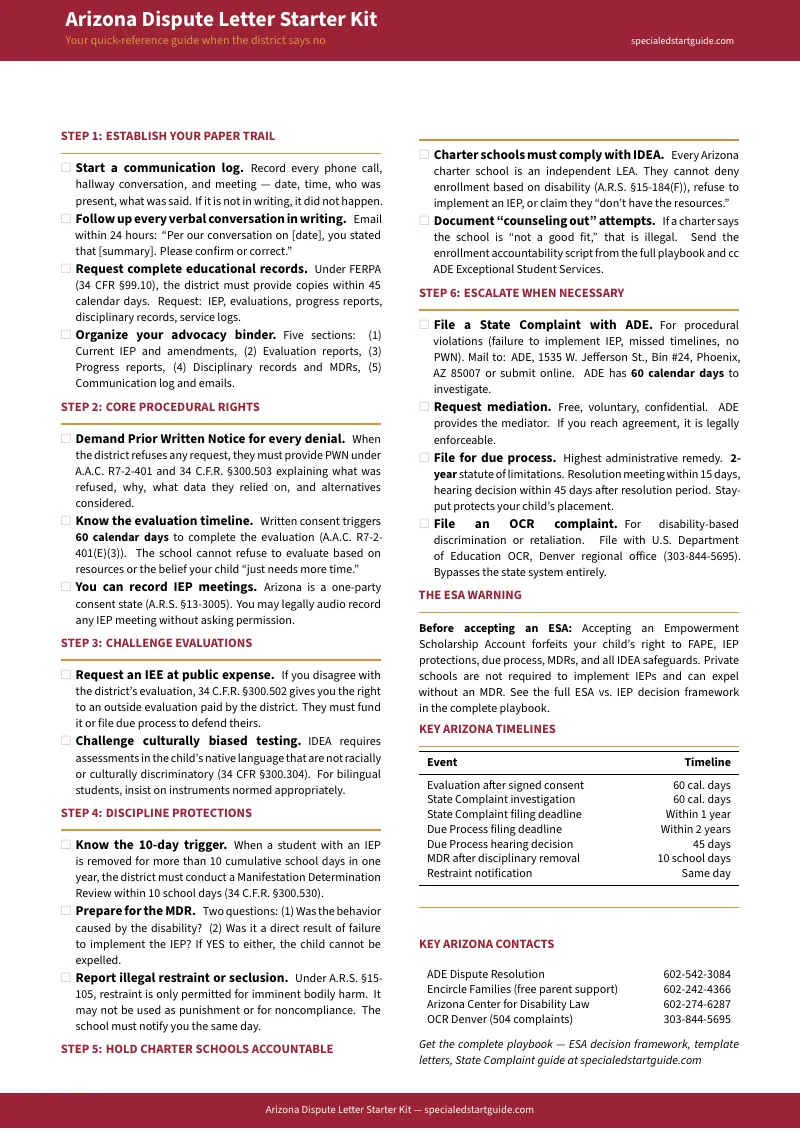
- Dispute Letter Starter Kit — Sample dispute letter template with A.A.C. R7-2-401 citations and a one-page parent rights summary covering the 5 rights every Arizona parent must know, the ESA warning, and key Arizona contacts
Instant PDF download. Print the dispute letter tonight. Send it to the school tomorrow morning with Arizona law backing every sentence.
Money-back guarantee, no time limit. If the Playbook doesn't change how you handle disputes with Arizona schools, email us for a full refund. No questions asked.
Not ready for the full Playbook? Download the free Arizona Dispute Letter Starter Kit — a sample dispute letter template citing A.A.C. R7-2-401 plus a one-page parent rights summary with the 5 rights every Arizona parent must know, the ESA warning, and key Arizona contacts. It's enough to draft your first formal letter tonight, and it's free.
Your child's education is a legal right — not a resource allocation decision the charter school gets to make unilaterally. The dispute letter you send tomorrow is the first step toward making them prove it.