
The School Said No. The LA Upheld It. You Have 8 Weeks to Appeal — and Most Parents Don't Know Where to Start.
Your child's school decided they don't have Additional Learning Needs. Or they issued an IDP so vague it promises "access to support when needed" — wording that does not say what support will be provided or when. You requested the local authority reconsider, and the LA sided with the school. You have been told, politely, that the system has worked as intended.
It hasn't. After the local authority reconsiders the school's decision, you can appeal the local authority's final decision to the Education Tribunal for Wales. The usual appeal window is 8 weeks from the date of its final decision letter. If you use the local authority's Disagreement Resolution Service before appealing, the deadline extends to 16 weeks from that letter. An annual IDP review is a separate process.
You've searched for help. What you've found is English EHCP advice that will actively damage your case if you cite it, fragmented SNAP Cymru factsheets scattered across dozens of web pages, and law firms quoting £250 per hour for an initial consultation. What you haven't found is a single resource that walks you through the entire Welsh dispute process — from challenging a No ALN decision to preparing your case for the Education Tribunal — in one document you can download tonight.
The Welsh ALN Dispute Escalation System is the structured battle plan that takes you from "the school said no" to "the Tribunal has ordered the LA to act." Every letter, every checklist, and every legal citation is grounded in the Welsh ALN framework, with related education law used where relevant. No English terminology. No EHCP crossovers. No guesswork about which law applies to your child.
What's Inside the Dispute Playbook
The Dispute Escalation Ladder
Most parents jump straight to a tribunal application or give up entirely. Neither is the right move. The Welsh system has a specific sequence of escalation stages — school decision, LA reconsideration, Disagreement Resolution Service, and the Education Tribunal for Wales — and knowing exactly when to trigger each one is the difference between winning your case and wasting months on the wrong process. This section maps every stage, with the exact statutory citations, deadlines, and template letters for each escalation point.
The IDP Quality Evaluation
If your child already has an IDP, it may not be worth the paper it's printed on. Chapter 23 of the ALN Code says the description of Additional Learning Provision should be detailed, specific, and quantifiable. Where relevant, it should say how often the support is provided and describe the tasks, staff responsibilities, and any qualifications or training needed. An IDP that says "regular TA support" or "access to a quiet space" may not make clear what the school has committed to provide. This evaluation tool walks you through Section 2B line by line, flagging vague language and helping you draft a specific proposed revision. Schools use ambiguity to protect their budgets. This tool strips the ambiguity away.
The Evidence Framework
Tribunal cases are won or lost on evidence — and most parents don't start building their evidence file until the appeal has already been lodged. This framework shows you what to collect from day one: attainment data showing the gap widening over time, written records of failed interventions, email trails confirming undelivered provision, and independent professional recommendations versus what the school actually provides. If your case reaches the ETW, you hand your panel a structured file, not a carrier bag of printouts.
ETW Tribunal Step-by-Step
The Education Tribunal for Wales is designed to be accessible without a solicitor. But "accessible" does not mean "simple." You need to understand the appeal rights in Section 70 of the ALNET Act, the 8-week deadline (or 16 weeks if you use the local authority's Disagreement Resolution Service first), how to write your Case Statement, what the Working Document process involves, and how to present your case at the hearing. This section walks through every stage of the ETW process with template documents and practical guidance — so you prepare like someone who has done this before, even if this is your first tribunal.
Health Board Accountability
If a local authority or FEI refers your child's needs under Section 20 of the ALNET Act, the NHS body must consider whether a relevant treatment or service is likely to benefit your child. If it identifies one, that provision must appear in Section 2C of the IDP and the NHS body must secure it. In practice, the DECLO (Designated Education Clinical Lead Officer) system is structurally failing across Wales. Referrals go unanswered. Clinical provision disappears from IDPs during reviews. This section gives you a template letter to ask the responsible local authority or FEI to make a referral, plus steps to contact the health board's DECLO about its progress.
Welsh-Medium Provision Rights
If your child learns through the medium of Welsh and the local authority says it cannot provide ALN support bilingually, you have a specific legal route to challenge that. Where the IDP specifies that Additional Learning Provision should be provided in Welsh, the body maintaining the IDP (or the NHS body securing the provision) must take "all reasonable steps" to secure it in Welsh. The Children's Commissioner has documented the "fundamental injustice" of Welsh-medium pupils being forced into English-medium settings to receive support. This section gives you the legal framework and template letters to challenge workforce excuses and demand bilingual provision.
Template Letters for Every Dispute Stage
Six ready-to-send template letters, citing the relevant provisions of the ALNET Act 2018 or the ALN Code for Wales 2021. Request an ALN decision. Challenge a No ALN decision. Ask the local authority to reconsider a school decision. Complain about an IDP's unclear ALP description. Request a Section 20 health referral. Challenge a failure to secure Welsh-medium provision. Fill in the bracketed details, send by email for a timestamp, and you have a legal paper trail from the first letter.
Who This Dispute Playbook Is For
- Parents whose child's school has issued a "No ALN" decision — and who need to know exactly how to force the school or LA to reconsider
- Parents who have an IDP but suspect it's deliberately vague — and want to audit it against the legal standard before the next review
- Parents who've exhausted LA reconsideration and need to prepare a case for the Education Tribunal for Wales — without hiring a solicitor
- Parents whose child is being excluded, put on a reduced timetable, or informally "off-rolled" because the school lacks the resources to manage their needs
- Parents whose child's SEN Statement or School Action Plus plan was converted to an IDP with quietly reduced provision during the transition
- Parents whose child needs NHS-delivered therapy that keeps being missed, delayed, or dropped from the IDP entirely
- Parents of Welsh-medium learners being told bilingual ALN support is "not available" — when the law says otherwise
- Families who've moved from England and discovered their child's EHCP has no legal standing in Wales — and need to understand the completely different dispute framework
Why Not Just Use SNAP Cymru and the Free Advice?
SNAP Cymru is the best free advocacy service in Wales. Their information is legally accurate and their helpline advisors are excellent. Here's the problem: when you receive a refusal letter on a Friday afternoon and the 8-week appeal clock starts ticking, SNAP Cymru's helpline is available two days per week for four hours. Their factsheets are spread across dozens of separate web pages. And no free resource — from SNAP Cymru, the Welsh Government, or your local authority — will teach you how to build a tribunal case against the institution that wrote the resource.
- SNAP Cymru tells you your rights. This Playbook gives you the template letters to enforce them — tonight, not when an advisor calls back.
- The Welsh Government toolkit explains how the system should work. This Playbook tells you exactly what to do when the system says No.
- Your LA's parent guide emphasises partnership and collaboration. When the LA is the one refusing provision, their guide is not going to teach you how to appeal their own decision to the Tribunal.
- English SEND advice will destroy your case. Citing EHCPs, the SEND Code of Practice, or SENDIST to a Welsh ALNCo signals that you don't understand the jurisdiction — and gives them permission to dismiss your objections.
Free resources explain the rules. This Playbook gives you the strategy for when they break them.
— Less Than 15 Minutes With a Specialist Solicitor
A specialist education solicitor charges £200–£350 per hour. Even a private ALN consultant charges £110 per hour. The evidence framework you build with this Playbook saves hours of professional fees if you do escalate to the Education Tribunal, because you're handing your panel an organised case file with statutory citations — not a folder of unsigned IDPs and half-remembered meeting summaries.
Your download includes 6 printable PDFs:
- Complete Dispute Playbook Guide — 11 chapters covering legal rights and breached duties, challenging No ALN decisions, IDP quality evaluation, the full dispute escalation ladder, ETW tribunal preparation and hearing strategy, health board accountability through Section 20 and DECLO escalation, Welsh-medium provision rights, exclusions and reduced timetable challenges, alternative escalation routes (Ombudsman, Welsh Language Commissioner, Senedd Members), and 6 template letters for every dispute stage
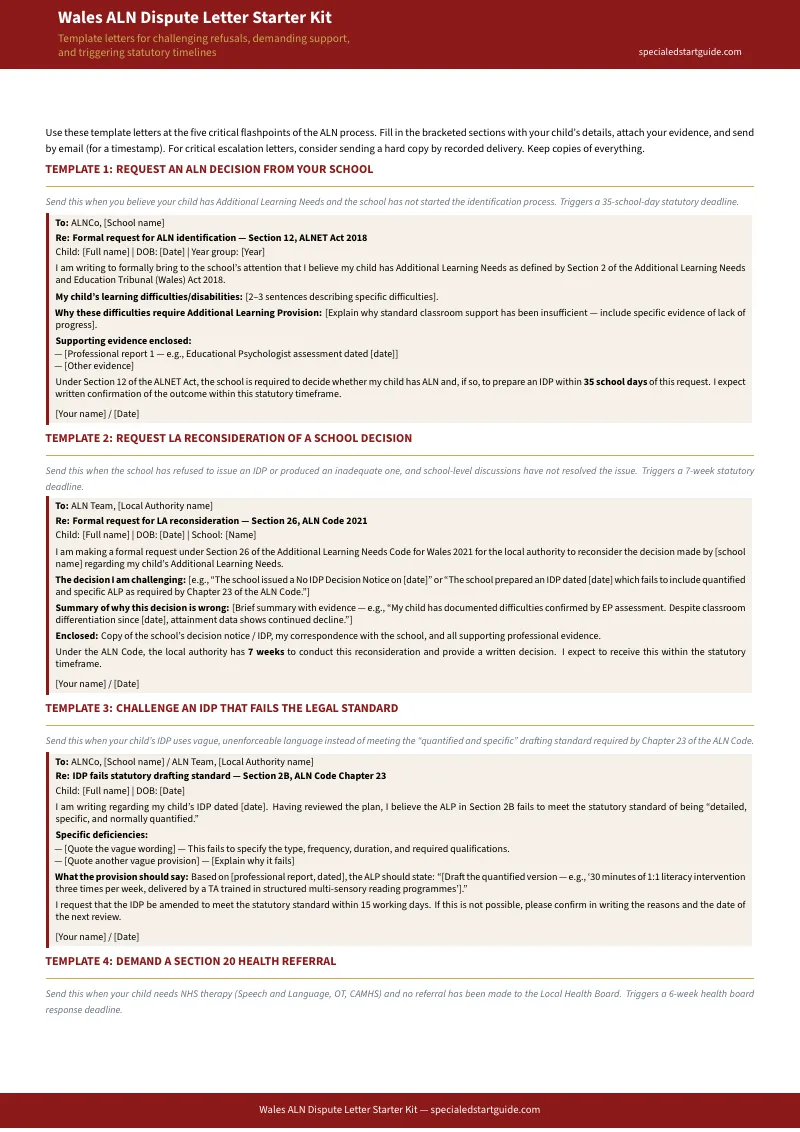
- Dispute Letter Starter Kit — 5 ready-to-send template letters covering the most common ALN disputes: requesting a school ALN decision, asking for local-authority reconsideration, challenging unclear IDP provision, requesting a Section 20 health referral, and challenging an unofficial exclusion or reduced timetable
- IDP Quality Audit Checklist — the 4-question test and section-by-section audit you print and bring to IDP review meetings, with a vague-vs-enforceable language comparison table
- Evidence Gathering Checklist — a structured checklist of everything to collect from day one so your case file is Tribunal-ready before you lodge the appeal
- Template Dispute Letters — all 6 template letters from the guide in a standalone printable format, ready to fill in and send tonight
- Statutory Deadlines Reference Card — every legal deadline on one page, with key escalation contacts — tape it to the fridge
Instant PDF download. Print what you need tonight. Start building your case before the appeal window closes.
Full refund, no time limit. If the Playbook doesn't change how you approach your ALN dispute, email us for a full refund. No questions asked.
Not ready for the full Playbook? Download the free Wales ALN Dispute Letter Starter Kit — five templates for requesting an ALN decision, local-authority reconsideration, IDP quality, a Section 20 health referral, and challenging an unofficial exclusion or reduced timetable. They cite the relevant Welsh ALN and education-law provisions for each situation. It's enough to send your first challenge letter tonight, and it's free.
Already have the companion Wales IDP & ALN Blueprint? That guide covers how the system works. This Playbook covers what to do when the system refuses to work. Together, they give you the complete toolkit — from understanding your rights to enforcing them at the Education Tribunal.
The appeal window is 8 weeks. The local authority is counting on you not knowing the process. After tonight, you will.
Frequently Asked Questions
What if the rules change after I buy?
We update the guide when the rules change. Email us any time, even years later, and we'll send you the current edition free.