
The School Knows PEI Policy. Now You Will Too.
You sat in that IEP meeting ready — or you thought you were. You searched online, read everything, brought your child's report cards. And then the team smiled, referenced SNAP forms and Student Services and tiered supports, and told you your child "just needs more time" or "we don't have an EA available right now." You left the meeting with the same plan your child walked in with. No new supports. No assessment timeline. No written explanation of why they refused your requests — because you didn't know you could demand one.
The problem isn't that you're uninformed. The problem is that Prince Edward Island's special education system operates in a policy vacuum that exists nowhere else in Canada. The province repealed its Minister's Directive on Special Education in 2016 and has never fully replaced it. Inclusion is the philosophy — every child in their neighbourhood school — but the system supporting that philosophy received 2,131 SNAP requests against roughly 626 funded support positions. That is three and a half requests for every single position. The assessment waitlist historically stretches past three years. And if you searched online for help, nearly everything you found references American law — IDEA, 504 Plans, due process hearings — none of which exist on Prince Edward Island.
The Prince Edward Island IEP & Support Plan Blueprint is the tactical navigation toolkit that bridges the gap between knowing your child has rights and actually exercising them — with every template, script, and checklist grounded in PEI's Education Act, Minister's Directive 2025-08, and the PEI Human Rights Act.
What's Inside the Blueprint
The Copy-Paste PSB Advocacy Email Library
Five crisis-ready email templates, each pre-loaded with the exact Education Act section, Minister's Directive provision, or Human Rights Act citation that triggers a legal obligation. Request a formal IEP review following a suspension. Refuse an informal partial-day arrangement that denies your child's right to full-day instruction. Challenge the removal of EA support. Demand raw data and incident reports from a seclusion or restraint event. Request an immediate SNAP referral when the school stalls. These aren't generic letters — they're PEI-specific enforcement tools that create a legally binding paper trail the moment you hit send.
The Post-2016 Policy Vacuum Decoded
PEI repealed its comprehensive special education directive in 2016 and never fully replaced it. The current framework relies on Minister's Directive 2025-08, which defines the IEP and mandates how progress is reported — but is narrower in scope than what was repealed. This means inclusion on PEI currently depends on individual school capacity rather than enforceable policy standards. The Blueprint explains exactly what this vacuum means for your child's rights, what legal protections still apply through the Education Act and Human Rights Act, and how to use human rights law when policy language fails you.
The PEI Terminology Decoder
Walk into a Charlottetown or Summerside school referencing a "504 Plan," an "IPRC meeting," or your rights under "IDEA," and the administration immediately knows you don't understand PEI's system — your credibility evaporates before the meeting starts. PEI calls its planning document an IEP — not an IPP like Nova Scotia or an IPRC placement like Ontario. The Blueprint provides the complete terminology translation so you use the correct language from day one: SNAP forms, Resource Teachers, Educational Assistants, Student Services, Director of Student Services, MTSS, RTI — every term mapped to its role in PEI's system.
The IEP Meeting Prep System
The school tells parents to "share information about your child" at IEP meetings. That advice is so passive it's designed to fail. The Blueprint's meeting system covers what documentation to bring, how to request the draft IEP in advance, how to verify the administrator present has decision-making authority, the exact questions to ask when the plan arrives pre-completed, and how to reject vague goals like "student will improve behaviour" and demand measurable, data-driven accommodations — because if the IEP was finished before you walked in, the school decided without you.
The Assessment Waitlist Survival Strategy
Public psychoeducational assessments on PEI have historically been backlogged by years. The system triages by severity — students with acute safety needs go first while children with moderate learning disabilities sit in a holding pattern that can span their entire elementary school career. The Blueprint explains how the SNAP process triggers assessment referrals, what RTI documentation strengthens your child's case, how to use private assessments ($3,200–$3,850) strategically if you can afford one, and the Medical Expense Tax Credit that offsets private assessment costs. Most critically, it gives you the exact language to demand interim classroom accommodations while your child waits — because the duty to accommodate under the PEI Human Rights Act does not pause pending an assessment.
The Grievance Escalation Map
When advocacy fails at the classroom level, you need to know where to go — and most PEI parents don't. The province has no formal due process hearings. Your escalation pathway runs from Teacher to Principal to Director of Student Services to Director to Board of Trustees. Beyond that, Section 86 of the Education Act provides the right to a formal appeal to a Hearing Committee for decisions that significantly affect your child's education, health, or safety. And the PEI Human Rights Commission handles disability discrimination complaints. The Blueprint maps every step with template communications for each level — so you escalate strategically, not blindly.
Eight Step-by-Step Scenario Walkthroughs
Not theory — concrete action plans for the specific situations PEI parents actually face. The pre-completed IEP. The sudden EA removal. The informal exclusion disguised as a partial day. The newcomer family whose Ontario IEP is being ignored. The assessment bottleneck. The transition from Early Years Autism Services to kindergarten. The rural school with no specialists. The seclusion room incident. Each walkthrough maps the exact steps from first email to final resolution.
Who This Blueprint Is For
- Parents navigating the Public Schools Branch or CSLF — in Charlottetown, Stratford, Summerside, Montague, Souris, or deep rural West Prince and Kings County
- Parents whose child is on informal "partial days" — sent home repeatedly for dysregulation without a formal suspension — and who need to assert their child's right to full-day instruction
- Parents stuck on a multi-year public assessment waitlist who need to secure interim accommodations through the MTSS framework while they wait
- Parents who moved to PEI from Ontario, Alberta, or another province and discovered the school cannot or will not honour the accommodations their child was already receiving
- Parents preparing for an IEP meeting who don't want to walk in outgunned by a team that does this every day
- Parents whose child transitioned from Early Years Autism Services into the school system and watched the intensive behavioural supports vanish overnight
- Rural families where the Resource Teacher covers multiple schools and the nearest private assessment is in Charlottetown — and nobody is offering interim supports
- Parents who've contacted LDAPEI, PEIACL, or the Autism Society and been told they have waitlists or the child's needs fall outside their mandate
Why Not Just Use the Free Resources?
PEI has dedicated organizations doing critical work for families. LDAPEI offers exceptional reading and math programs. PEIACL advocates can attend school meetings with you. The Autism Society provides navigation for autism-spectrum families. Here's why parents still struggle after consulting all of them:
- PEI has no comprehensive special education policy directive. The Minister's Directive on Special Education was repealed in 2016. The current framework is a patchwork of directives, operational procedures, and institutional practice — and no free guide maps how the pieces fit together or what to do when they break down.
- PEIACL primarily serves families with intellectual disabilities. Their advocates are valuable but their mandate is defined — if your child has severe ADHD, profound dyslexia, or behavioural challenges without a comorbid intellectual disability marker, you may fall outside their scope.
- The Autism Society serves only autism-spectrum families — with waitlists. If your child's needs don't involve an ASD diagnosis, their services are not available. Even within their mandate, limited capacity means delays.
- LDAPEI focuses on pedagogical strategies, not escalation. Their public resources emphasize building good relationships with teachers — writing thank-you notes, nominating teachers for awards. Collaboration is essential. But it does not cover what to do when the principal flatly refuses an accommodation due to budget constraints.
- American and Ontario IEP guides destroy your credibility. Walk into a PSB school referencing a "504 Plan," an "IPRC meeting," or your rights under "IDEA," and the administration immediately knows you haven't done your homework. These terms do not exist on Prince Edward Island.
The free resources describe what the system should look like. The Blueprint gives you the tools to make the system actually work for your child.
— Less Than a Single Lawyer Consultation
Community Legal Information offers a $25 lawyer referral for a 45-minute consultation. Private educational advocates charge hourly rates that add up fast. Private assessments cost $3,200 to $3,850. For less than a single brief legal consultation, you gain immediate, lifetime access to the exact templates, checklists, and inside local knowledge required to make the Public Schools Branch take your child's needs seriously — starting tonight.
Your download includes the complete Blueprint guide plus four standalone printable tools:
- Complete Blueprint Guide (guide.pdf) — 11 chapters covering the PEI landscape, legal framework (Education Act, Minister's Directive 2025-08, Charter rights, Human Rights Act), the tiered support framework, SNAP process and assessment pathway, IEP components and red flags, placement and service delivery, dispute resolution and the Section 86 appeal, five crisis email templates, eight step-by-step scenario walkthroughs, financial strategies and tax recovery, and the PEI resources directory
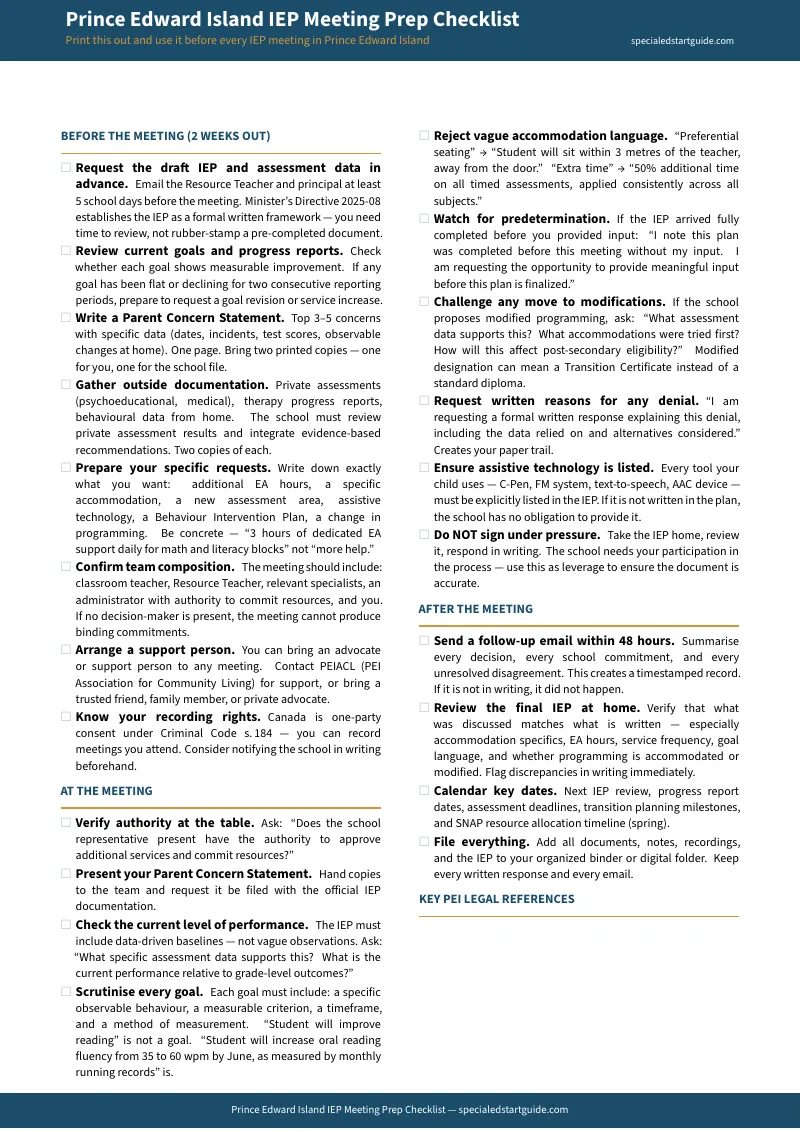
- IEP Meeting Prep Checklist (checklist.pdf) — the before/during/after checklist with PEI law citations, red flags requiring immediate action, and accommodation request prompts for every IEP meeting
- PSB Advocacy Email Templates (letter-templates.pdf) — five fill-in-the-blank crisis emails with exact Education Act, Minister's Directive 2025-08, and Human Rights Act citations for assessment requests, partial-day refusals, EA challenges, incident documentation, and formal escalation
- Escalation Pathway (escalation-pathway.pdf) — single-page fridge sheet mapping every step from classroom teacher to Section 86 Hearing Committee to PEI Human Rights Commission, with practical tips for each level
- PEI Terminology Cheat Sheet (terminology-cheat-sheet.pdf) — quick-reference card translating American and other-province terms into PEI's actual terminology, plus the accommodations vs. modifications distinction and jurisdiction comparison
Instant PDF download. Send your first advocacy email tonight. Walk into the next IEP meeting with PEI law on your side.
Money-back guarantee, no time limit. If the Blueprint doesn't change how you approach IEP meetings in Prince Edward Island, email us for a full refund. No questions asked.
Not ready for the full Blueprint? Download the free Prince Edward Island IEP Meeting Prep Checklist — a printable pre-meeting checklist with PEI terminology, Education Act citations, and red flags that require immediate action. It's enough to walk into your next meeting prepared, and it's free.
Your child's education is a legal right, not a favour the school grants when resources allow. The PSB knows PEI policy. After tonight, so will you.