
The Department Hid Their Funding Criteria Behind a Staff Intranet. This Guide Gives It Back to You.
You sat in a Student Support Group meeting surrounded by people who already knew the rules. The Learning Support Coordinator slid a document across the table — your child's Documented Plan — and waited for you to sign. The goals were vague. The adjustments were verbal promises. The acronyms blurred together: IDA, EAA, ABLEWA, SCSA, SSG, NCCD. And when you asked how many Education Assistant hours your child would actually get, the answer was "we'll see how the term goes."
You left that meeting without a plan. You left with a piece of paper that said your child would "improve their engagement" and "work towards grade-level expectations" — goals so vague that no one could ever be held accountable for failing to meet them. You went home and searched for help. You found American IEP guides that referenced 504 plans and IDEA — laws that don't exist here. You found Etsy templates designed for Texas classrooms. You found a ten-year-old DDWA handbook and a Department of Education website that redirected you to a policy document written for principals, not parents.
Western Australia runs one of the most opaque disability education systems in the country. The Department recently removed its diagnostic criteria for the Individual Disability Allocation from the public website and placed them behind the staff intranet — meaning parents and private practitioners can no longer see the exact medical evidence required to secure funding. The eight IDA categories are strict. The specialist conferral requirements are byzantine. And if your child's diagnosis falls outside those eight categories, you're left relying on the school's discretionary EAA budget with no transparency about how much exists or how it's allocated.
The WA Documented Plan Decoder is the parent's tactical translation of every funding pathway, legal obligation, and bureaucratic process in the WA disability education system — with the templates, scripts, and checklists that turn policy knowledge into meeting-room leverage.
What's Inside
The IDA Funding Decoder
The Individual Disability Allocation is the most significant source of targeted disability funding in WA schools — and the criteria are deliberately hard for parents to find. The guide maps all eight IDA-eligible categories (Autism, Deaf and hard of hearing, Global developmental delay, Intellectual disability, Physical disability, Severe medical health condition, Severe mental health disorder, Vision impairment), explains exactly what medical evidence the Department requires for each, and details the specialist conferral bottleneck that rejects comprehensive private assessments lacking a paediatrician or psychiatrist sign-off. If your child's condition falls outside the eight categories — ADHD, dyslexia, anxiety — the guide explains the Educational Adjustment Allocation pathway and how to ensure the school uses those discretionary funds on actual adjustments, not administrative overhead.
The Documented Plan Audit System
A Documented Plan that says your child will "participate more in class" is not an actionable plan. It's a liability shield for the school. The guide provides SMART goal-writing worksheets aligned to the WA Curriculum and ABLEWA, plus an audit framework that tests every goal the school proposes against measurability, owner accountability, and review timelines. You'll know exactly what to push back on before you sign — and the legal basis for refusing to sign until the plan is rigorous.
The SSG Meeting Playbook
Student Support Group meetings are where your child's accommodations are decided. Parents report feeling outnumbered by panels of teachers, LSCs, and deputy principals — and experiencing "meeting amnesia" under stress. The guide includes a pre-meeting preparation checklist, a question bank tied to specific DSE 2005 obligations, and a post-meeting accountability framework that turns verbal promises into written commitments. You walk in with an agenda. You leave with documented actions, named owners, and review dates.
The ESC vs Mainstream Decision Matrix
The choice between an Education Support Centre and mainstream placement is one of the most consequential decisions you'll make — and online forums are full of contradictory anecdotal advice. The guide provides the actual enrolment criteria: standard ESC enrolment requires an intellectual disability diagnosis or autism with demonstrated high educational need generating an IDA. It also explains the "Local Placement" mechanism that permits temporary ESC placement for up to one year for students who don't meet standard criteria. You get a structured decision framework, not forum opinions.
The WACE and SCSA Accommodation Templates
If your child reaches Year 11 without SCSA equitable access adjustments in place, their WACE and ATAR outcomes can be permanently compromised. The guide maps the full application process for OLNA and ATAR examination adjustments — extra working time, rest breaks, scribes, pause buttons, alternate formats — including the specific evidence requirements (PAT-R 4th edition for reading disabilities) and the deadlines that the school may not volunteer. It also covers alternative pathways: ASDAN, VET, and the WASSA, so you can make an informed choice rather than defaulting to whatever the school suggests.
The Complete Escalation Pathway
When the school refuses to implement the Documented Plan, when the IDA application is denied, when the EA hours evaporate — you need to know exactly who to call and in what order. The guide maps the full complaint and dispute resolution pathway: informal resolution with the principal, escalation to the Regional Education Office (with contact numbers for every region), formal complaints to the Department of Education, the role of PWdWA and DDWA as independent advocacy bodies, and when to seek formal legal advice from Sussex Street Community Law Service. Every step includes a letter framework you can adapt.
The WA Terminology Translator
Western Australia's disability education vocabulary creates an immediate barrier for parents — especially those who've relocated from eastern states. The guide includes a comprehensive translation table mapping every WA term (Documented Plan, IDA, EAA, LSC, SSEN, ABLEWA, SCSA) to its eastern states equivalent and plain-language definition. If you've moved from NSW or Victoria, you'll understand exactly how the WA system differs from Schools Plus or the Disability Inclusion Profile — and why your existing documentation may need to be re-presented under WA criteria.
Who This Guide Is For
- Parents whose child has just been diagnosed — or whose school has imputed a disability — and who are being asked to co-sign a Documented Plan they don't fully understand
- Parents whose child has ADHD, dyslexia, or anxiety and has been told they "don't qualify" for IDA funding — who need to know the EAA pathway and how to hold the school accountable for adjustments without targeted funding
- Parents navigating the decision between an Education Support Centre and mainstream placement — who need the actual criteria, not forum opinions from other parents
- Parents of Year 8-10 students who need to secure SCSA equitable access adjustments for OLNA and ATAR examinations before it's too late
- Families who've relocated from NSW, Victoria, or Queensland and are discovering that WA doesn't recognise their existing educational documentation — and that the system uses entirely different terminology and funding structures
- Regional and remote families in the Pilbara, Kimberley, South West, or Goldfields who face specialist shortages, telehealth barriers, and schools operating with reduced EA staffing
- FIFO families managing disability advocacy across two households and irregular school attendance patterns
Why Not Just Use the Free Resources?
Western Australia has free advocacy resources. DDWA publishes a parent guide to Documented Plans. PWdWA offers individual advocacy. The Department of Education has policy documents online. Here's why parents still struggle after consulting all of them:
- The DDWA handbook dates to 2016. The philosophy of inclusion it describes remains valid, but the tactical landscape has shifted: NCCD integration, the 2023 Autism CRC guidelines, and the Department's decision to remove IDA diagnostic criteria from public access have all changed the game. The handbook tells you what a Documented Plan is — it doesn't give you the fillable SMART goal worksheet to bring to tomorrow's SSG meeting.
- Department of Education policy documents are written for administrators, not parents. They explain compliance requirements for principals and LSCs. They do not explain how to challenge an inadequate Documented Plan, how to present private assessment evidence, or what to do when the school claims "we don't have the funding." Critical diagnostic criteria documents have been moved behind the staff intranet — parents literally cannot access the evidence standards their child is being assessed against.
- PWdWA and DDWA advocacy services have waitlists. When the school emails an inadequate Documented Plan on a Friday afternoon and your SSG meeting is next Wednesday, you cannot wait four weeks for an advocacy intake. The guide is available the moment the crisis hits.
- American IEP templates are actively dangerous in WA. A guide that teaches you to demand a "504 Plan" or cite "IDEA" marks you as uninformed in a system that runs on Documented Plans, IDA categories, and ABLEWA. The terminology mismatch destroys your credibility at the table — the school team immediately knows you're working from the wrong playbook.
The free resources explain the philosophy. This guide gives you the tactical tools to enforce the obligations.
— Less Than Ten Minutes With a Perth Educational Consultant
Perth-based educational consultants and disability advocates charge $150 or more per hour. A single two-hour planning meeting costs $300. The guide gives you the same foundational templates, funding decoders, and meeting strategies that professional advocates use — so if you do hire one, you skip the $150 orientation session where they explain what an IDA is, and your consultant can immediately focus on the complex tactical work only a professional can do.
Your download includes the complete Blueprint guide plus 8 standalone printable PDFs — every tool you need to walk into an SSG meeting prepared:
- Complete Blueprint Guide (guide.pdf) — 12 chapters covering legal rights, IDA and EAA funding, Documented Plans, SMART goals, assessments, ESC vs mainstream, classroom adjustments by disability profile, WACE and SCSA accommodations, transitions, disputes and escalation, Aboriginal and Torres Strait Islander considerations, regional and FIFO family strategies, and templates
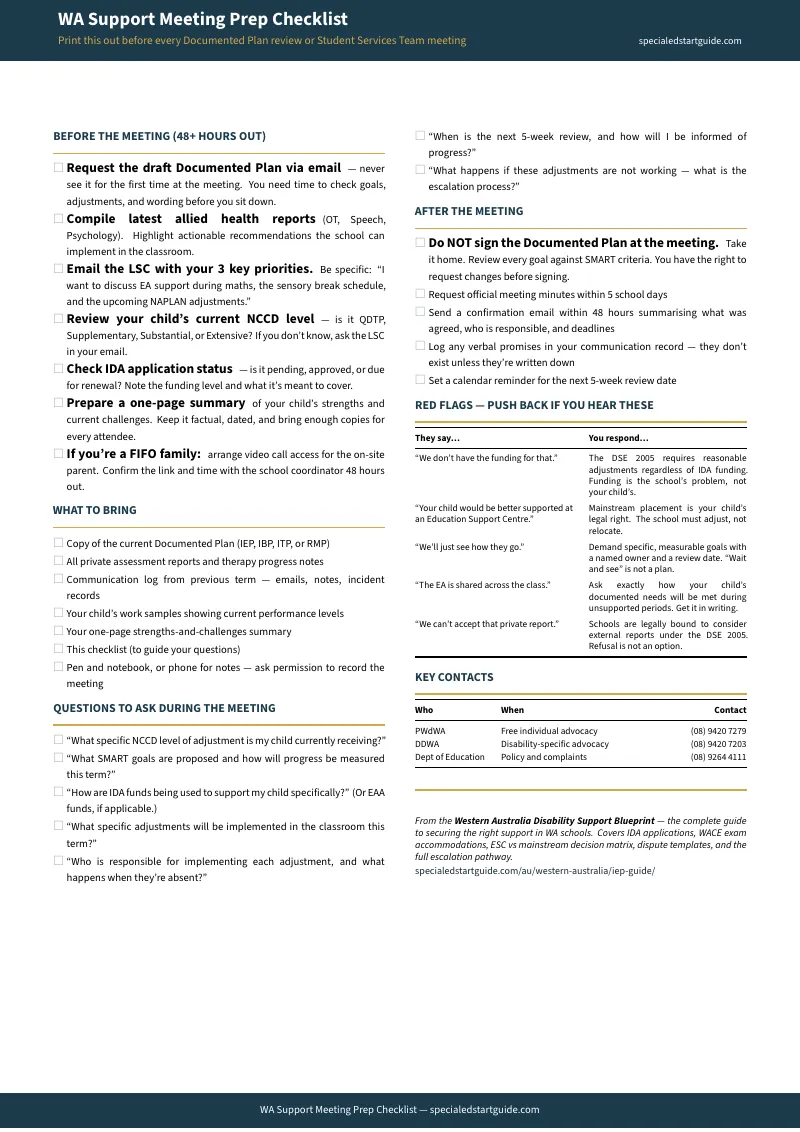
- WA Support Meeting Prep Checklist (checklist.pdf) — the before/during/after checklist with WA-specific questions, red-flag responses, and key contacts
- SMART Goal Audit Worksheet (smart-goal-worksheet.pdf) — weak vs strong goal examples and fill-in goal writing templates aligned to the WA Curriculum and ABLEWA
- Email Templates (email-templates.pdf) — 6 ready-to-send templates: formal assessment request, post-meeting summary, "no diagnosis required" demand, NCCD level inquiry, funding challenge script, and DoE Regional Office complaint
- ESC vs Mainstream Decision Matrix (esc-decision-matrix.pdf) — side-by-side comparison table with enrolment criteria, Local Placement explanation, and structured decision checklist
- IDA Appeal Evidence Checklist (ida-appeal-checklist.pdf) — every document you need to gather before lodging an appeal, with the 28-day deadline warning
- WA Terminology Translator (terminology-translator.pdf) — 19 WA terms mapped to plain language and eastern states equivalents on one printable page
- Key Contacts & Escalation Pathway (key-contacts.pdf) — fridge sheet with DoE, Regional Education Offices, PWdWA, DDWA, EOC WA, WA Ombudsman, and AHRC contact details
- Communication Log (communication-log.pdf) — printable tracking sheet for every school interaction — your evidence trail if you ever need to escalate
Instant PDF download. Print the checklist and communication log tonight. Walk into your next SSG meeting knowing the system as well as the professionals on the other side of the table.
Money-back guarantee, no time limit. If the Blueprint doesn't change how you approach disability support meetings in WA schools, email us for a full refund. No questions asked.
Not ready for the full Blueprint? Download the free WA Support Meeting Prep Checklist — a printable pre-meeting checklist covering what to bring, questions to ask, red flags to watch for, and the key contacts every WA parent should have. It's enough to walk into your next meeting prepared, and it's free.
Your child's right to reasonable adjustments is not discretionary. The school knows the DSE 2005 obligations. After tonight, so will you.