
The School Has a Legal Team. You Have Sunday Night and a Laptop. Let's Fix That.
You've been sitting across from principals and coordinators at SSG meetings for years. You've raised the same concerns. You've emailed. You've called. And each time, you've heard variations of the same script: "we're working on it," "the funding isn't there," "we're doing everything we can."
Meanwhile, the IEP adjustments agreed upon last term still haven't appeared. Your child was sent home early three times this month — no formal suspension, no paperwork, just a phone call. The Disability Inclusion Profile outcome doesn't reflect the child you know. And you've been told, again, that the school "can't provide that level of support without additional funding."
You've read the DET website. You've called ACD Victoria — but they're on a waitlist. Amaze helped with autism-specific questions, but your child's situation cuts across multiple systems: the DIP, the IEP, the SSG process, and now a reduced timetable nobody asked you to consent to. You need to know what to do tonight, not after a three-week callback.
The Victoria Disability Advocacy Playbook is a dispute-resolution system built specifically for Victorian parents who've exhausted collaboration and need to escalate. It gives you the exact letter templates, complaint procedures, legal citations, and escalation pathways to move from ignored to impossible-to-ignore — grounded in the Disability Standards for Education 2005, Victoria's Equal Opportunity Act 2010, and the Department of Education's own published policy.
What's Inside the Playbook
12 Fill-in-the-Blank Dispute Letter Templates
Every letter cites the specific legislation and DET policy that applies to the situation. You replace the bracketed details with your child's information and send. Templates cover the twelve most common dispute scenarios Victorian parents face: requesting reasonable adjustments when the school claims "no funding," challenging a Disability Inclusion Profile outcome, escalating unimplemented IEP goals, responding to informal exclusions and unauthorised reduced timetables, demanding the school act on external professional recommendations, filing formal complaints with the DET Regional Office, escalating to the Independent Office for School Dispute Resolution, lodging VEOHRC discrimination complaints, and AHRC federal complaints. Each template is professionally structured to position you as a documented, legally informed advocate — not a frustrated parent writing another emotional email at midnight.
The Complete Complaints Escalation Pathway
When the principal says no and means it, most parents don't know who to contact next. This section maps the full Victorian escalation ladder — classroom teacher to principal to DET Regional Office to Independent Office for School Dispute Resolution to Victorian Ombudsman to VEOHRC to AHRC. Each step includes who to contact, what to include in your complaint, what response timeframe to expect, and the specific trigger for escalating further. You stop guessing and start following a documented pathway that builds on every previous step.
DIP Dispute Resolution
The Disability Inclusion Profile determines whether your child qualifies for Tier 3 individualised funding. If the profile outcome doesn't reflect your child's functional needs, you have 15 school days to request a review through the principal. This section explains exactly how the review process works, what evidence strengthens a review request, how to frame functional needs in the "extensive adjustments" language the facilitator scores against, and the Enhanced Moderation pathway for complex cases. When the principal tells you the DIP outcome is final, you'll know it isn't.
IEP Accountability System
DET policy requires IEP goals to be Specific, Measurable, Agreed, Relevant, and Time-bound. Most Victorian IEPs meet none of these criteria. "Will improve social skills" is not a goal — it's an aspiration with no deadline, no measurement method, and no named person responsible. This section gives you the framework for identifying inadequate goals, the meeting script for requesting SMART-compliant rewrites, and the follow-up template for documenting when agreed adjustments aren't being implemented. The IEP stops being a compliance document the school files away and starts being an accountability tool you enforce.
Informal Exclusion Defence
Schools that cannot manage disability-related behaviour often resort to "informal exclusions" — calling parents to collect their child early without issuing a formal suspension. Under DET policy, reduced timetables require your written consent, a documented return-to-full-time plan, and a specified end date. Without these, the arrangement is potentially unlawful. This section gives you the letter template to challenge an informal exclusion, the policy references that establish the school's obligations, and the escalation pathway when the principal refuses to restore full-time attendance.
External Report Refusal Response
You paid $800 for a paediatric assessment. The psychologist recommended specific classroom adjustments. The school looked at the report and said "we'll take it on board" — then continued with the same approach. Under the DSE 2005, schools must consult with you and consider the recommendations of treating professionals. This section gives you the response framework for when schools refuse to act on external professional reports, including the letter template that places the obligation back on the school to explain why the recommended adjustments cannot be provided.
VCAA Special Examination Arrangements
Your child's VCE results should reflect their actual ability, not the barriers created by an exam environment that doesn't accommodate their disability. VCAA requires extensive evidence of provisions being trialled and used in school assessments — parents who discover this in Year 12 are too late. This section maps the preparation pathway from Year 9 onwards, the evidence portfolio requirements, conditions-to-provisions mapping, and the SEA application process.
NDIS-School Coordination Disputes
If your child has NDIS funding, the boundary between what the school must provide (educational adjustments) and what the NDIS funds (disability supports beyond education) generates constant confusion. Schools often refuse to provide adjustments by claiming "that's an NDIS matter." This section clarifies the responsibilities, gives you the response when a school tries to shift its obligations onto NDIS, and provides the escalation pathway when coordination breaks down.
Evidence System Framework
Every escalation you make is only as strong as the documentation behind it. This section gives you the evidence logging system — what to save, how to organise it, and how to create a chronological record that transforms weeks of frustration into a structured case file. When you eventually meet with a regional director or lodge a formal complaint, your documentation tells the story without requiring you to recount every incident from memory.
Who This Playbook Is For
- Parents whose child has a disability — diagnosed, suspected, or imputed — and is enrolled in or entering a Victorian government, Catholic, or independent school
- Parents who've tried collaboration and need to escalate because nothing has changed
- Parents facing an SSG meeting where the school is likely to push back on adjustments, funding, or placement
- Parents whose child's DIP outcome doesn't match their functional needs and who need to request a review
- Parents whose child has been informally excluded, suspended, or placed on a reduced timetable without documented consent
- Parents whose school ignores external professional recommendations for classroom adjustments
- Parents of VCE students who need to build the evidence portfolio for Special Examination Arrangements before time runs out
- Parents whose child has NDIS funding and whose school keeps saying "that's an NDIS matter" for adjustments that are the school's responsibility
- Families in regional and rural Victoria — Geelong, Ballarat, Bendigo, Shepparton, Mildura, Warrnambool, the Latrobe Valley — where local advocacy services are scarce and the advocacy toolkit needs to travel with you
Why Not Just Use the Free Resources?
DET's Policy and Advisory Library tells you the school must make reasonable adjustments. ACD Victoria confirms it. Amaze explains what those adjustments might look like for autistic students. None of them give you the dispute letter to send tonight when the school refuses to put an agreed adjustment in writing.
- DET resources explain the school's policies. This Playbook gives you the tools for when the school ignores them — the letter templates, complaint procedures, and escalation pathways the DET website leaves out.
- ACD Victoria offers excellent free advocacy support. But when you need to send a formal email before tomorrow's meeting and the support line opens at 9 AM, this Playbook is the advocate in your inbox tonight.
- Amaze is the gold standard for autism-specific guidance. But if your child has intellectual disability, ADHD, dyslexia, or a physical condition, Amaze's resources don't cover the dispute strategy for those disability types.
- Etsy and Amazon sell special education guides for US families. They reference IDEA, Section 504, and due process hearings — none of which exist in Victoria. Using American terminology in a Victorian SSG meeting signals you don't understand the system you're navigating.
- Private advocates charge $150-$200 per hour. Education lawyers charge $300-$500. This Playbook gives you the same letter frameworks, escalation strategies, and legal citations those professionals use — at a fraction of a single billable hour.
The DET's free resources are designed to protect the Department's liability. This Playbook is designed to protect your child.
— Less Than 6 Minutes With a Private Disability Advocate
Private educational advocates in Victoria charge $150-$200 per hour. Education lawyers charge $300-$500. A single two-hour SSG attendance costs upwards of $400. This Playbook gives you the dispute templates, complaint procedures, and legal escalation pathways that professionals use — and you can reuse them at every meeting, every review, every year your child is in school.
Your download includes 6 PDFs, instant download:
- The Victoria Disability Advocacy Playbook (13 chapters) — Victoria's legal framework (DDA 1992, DSE 2005, Equal Opportunity Act 2010, Charter of Human Rights 2006), the Disability Inclusion three-tier funding model, DIP dispute resolution and Enhanced Moderation pathways, IEP accountability with SMART goal enforcement, SSG meeting strategy, informal exclusion defence, external report refusal responses, VCAA Special Examination Arrangements preparation, complaints escalation from principal to VEOHRC to AHRC, NDIS-school coordination disputes, 12 fill-in-the-blank dispute letter templates, the evidence system framework, and special considerations for suspensions and reduced timetables
- Dispute Letter Templates — all 12 fill-in-the-blank templates extracted as a standalone printable, one template per page. Print only the template you need tonight, fill in the brackets, send.
- Complaints Escalation Pathway — quick-reference card mapping the full Victorian escalation ladder from principal through DET Regional Office, Independent Dispute Resolution, VEOHRC, AHRC, to VCAT. Pin it to your desk.
- Evidence Log — printable tracking worksheet with a 7-category evidence file checklist, incident log table, correspondence tracker, and complaint escalation tracker. Keep it in your case folder.
- Advocacy Contacts — reference card with phone numbers and websites for peak advocacy bodies, regional services, legal services, complaint bodies, and NDIS coordination contacts across Victoria.
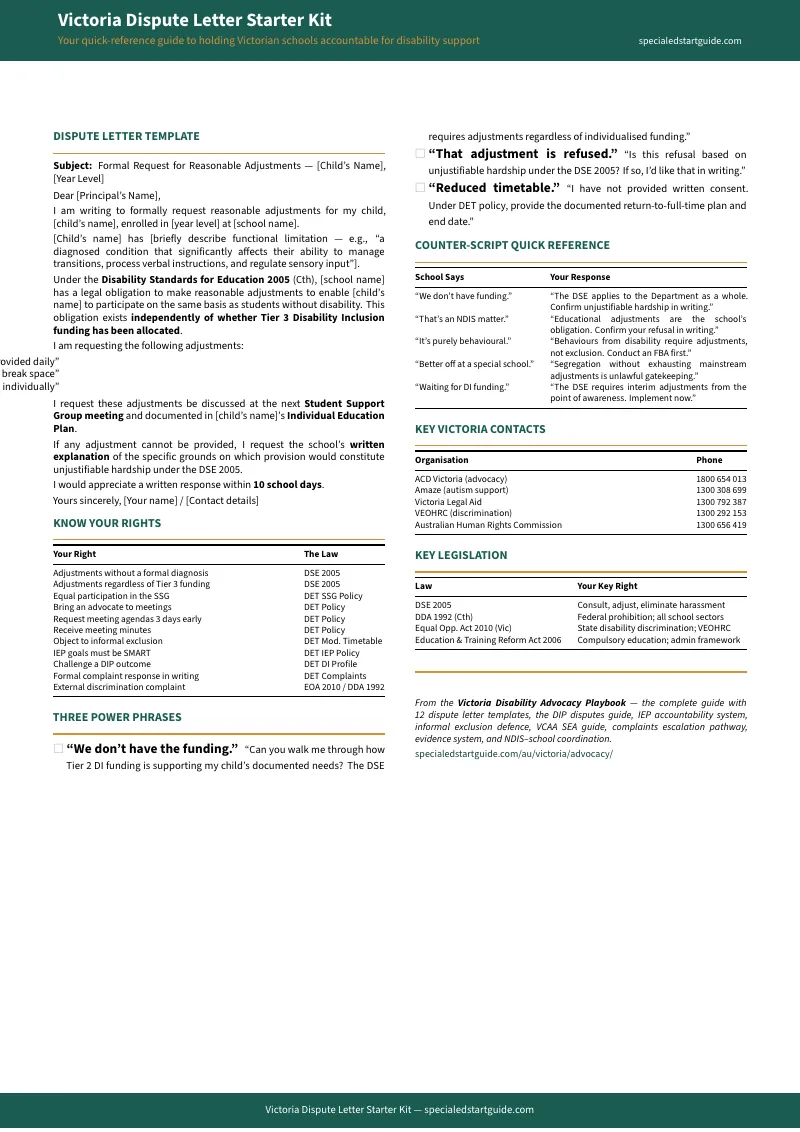
- Victoria Dispute Letter Starter Kit — sample dispute letter template citing the DSE 2005, parent rights quick-reference table, three power phrases for common school pushback scenarios, and key Victorian advocacy contacts
Instant PDF download. Print the letter templates tonight. Send the first one before your next SSG meeting.
Money-back guarantee, no time limit. If this Playbook doesn't change how you handle disputes with your child's school, email us for a full refund. No questions asked.
Not ready for the full Playbook? Download the free Victoria Dispute Letter Starter Kit — a sample dispute letter template, parent rights one-pager, and three power phrases you can use when the school pushes back. It's enough to send a legally grounded email tonight, and it's free.
The next time the school says "we can't do that," you'll know exactly what to say — and who to escalate to when they don't listen.