
Your Child Has Rights Under DSE 2005. The NT System Is Counting on You Not Knowing How to Use Them.
Your child's school says they support inclusive education. They held an ILP meeting and wrote some goals. Then the classroom teacher left at the end of term — and the replacement had never seen the plan. The goals were vague enough that no one could prove they weren't being met, because no one was measuring anything. The SWIPS team visits twice a term if you're lucky. The paediatrician your GP referred you to has a 12-month waitlist. And the school says they can't provide more support until the diagnosis comes through.
You tried the NT Department of Education website. It confirmed your child has a right to reasonable adjustments. What it did not explain is how to force the school to provide them when the principal says there's no funding, the visiting specialist only comes twice a term, and the nearest assessment clinic is an 8-hour drive away.
You called NT COGSO. They're genuinely helpful — but constrained by staff capacity and business hours. Carpentaria provides excellent therapy services, not educational advocacy. Your child's ILP review is next week.
The Northern Territory Disability Support Blueprint is the structured system that closes the gap between what the law promises and what actually happens in your child's classroom. It gives you the meeting tactics, copy-paste email scripts, legal frameworks, and escalation pathways that the Department's website deliberately leaves out — built specifically for the NT's ILP process, SWIPS referral system, NCCD funding model, imputed disability rules, and complaints framework.
What's Inside the Blueprint
The NT Legal Framework Decoder
Three layers of law protect your child: the Disability Discrimination Act 1992, the Disability Standards for Education 2005, and the NT Anti-Discrimination Act 1992. When a school says "we can't do that," you need to know which layer they're violating. This section translates all three into plain language with exact section references — including section 24(3) of the NT Act, which makes "failure to accommodate special need" a distinct form of discrimination. You cite the specific obligation. The school stops citing budget constraints.
The Imputed Disability Playbook
NT assessment waitlists run 6 to 24 months. The school says it can't act without a diagnosis. The law says otherwise. Under the DDA 1992, "imputed disability" means a school must provide adjustments even without a formal diagnosis — as long as there are reasonable grounds to believe disability is affecting learning. This section gives you the step-by-step process: what evidence to gather from your GP, preschool, or therapist, how to phrase the request, and the exact email template to send when the school claims their hands are tied.
The ILP Quality System
A good ILP has goals that are specific, measurable, and time-bound — with a named person responsible for each one. Most ILPs in NT schools have none of these things. This section walks you through evaluating your child's current ILP, rewriting vague goals into enforceable commitments, and building "turnover-proof" documentation that survives when the teacher leaves mid-year — because in the NT, that is not a possibility, it is a certainty.
The SWIPS Referral System
Student Wellbeing, Inclusion and Program Services teams are the NT's multidisciplinary support hubs — occupational therapists, speech therapists, psychologists, positive behaviour coaches. But SWIPS referrals must go through the school, not through you. This section shows you how to trigger a referral when the school won't initiate one, what the Parent Consent Authority form means, and how to ensure SWIPS recommendations are actually implemented in the classroom rather than filed and forgotten.
The Meeting Equaliser
ILP meetings feel rigged because they are structurally unbalanced: the school team sits on one side, and you sit on the other. This section gives you the pre-meeting preparation checklist, the conversational scripts, and the tactical responses for the phrases NT schools use to shut parents down — "we're doing our best with limited resources," "we need to wait for the diagnosis," "we'll try to implement that where possible." You walk in with a plan. You leave with documented commitments.
Copy-Paste Email Scripts
Every critical interaction with the school should happen in writing. This section gives you ready-to-send email templates for the situations NT parents face most often: requesting interim adjustments pending diagnosis, following up after a meeting to lock in agreements, requesting your child's NCCD level and funding allocation data, documenting a verbal refusal, escalating to the regional office, and filing a complaint with the NT Ombudsman. Fill in the bracketed details and send. The paper trail starts tonight.
The Escalation Ladder
When the school says no and means it, you need to know exactly who to contact next — and in what order. This section maps the full NT complaints pathway: school principal → regional Student Engagement office → Department Chief Executive → NT Anti-Discrimination Commission → Australian Human Rights Commission → NT Ombudsman. Each step includes who to contact, what to include, what response to expect, and when to escalate further.
The NDIS-School Interface
You pay for NDIS-funded therapy, but the school ignores the recommendations. Or worse — refuses to let the therapist on premises. This section covers the NDIS Service in Schools Agreement, how to get external therapists into the classroom, how to force telehealth recommendations into the ILP, and what to do in thin markets where no provider exists within driving distance.
Who This Blueprint Is For
- Parents whose child has a disability — diagnosed, suspected, or stuck on a waitlist — and is enrolled in or entering an NT school
- Parents facing an ILP or support meeting this term who want to walk in prepared with specific questions, legal references, and meeting tactics
- Parents whose child is on a 6-to-24-month assessment waitlist and need the school to act now — not after the diagnosis arrives
- Parents whose child's teacher has changed mid-year and the new teacher has never seen the ILP
- Defence families posted to Darwin, Tindal, or Robertson Barracks who need to transfer interstate support plans into the NT system
- FIFO and DIDO families where one parent manages all advocacy alone during extended work rosters
- Remote and very remote families dealing with limited specialist access, high teacher turnover, and telehealth-only therapy
- Parents whose child is being suspended, placed on a reduced timetable, or isolated because the school cannot manage disability-related behaviour
- Parents who have tried the Department's complaints process and hit a wall — and need the next escalation step
Why Not Just Use the Free Resources?
The NT Department of Education website will tell you that your child has a right to reasonable adjustments. NT COGSO will confirm it. Carpentaria will provide excellent therapy. None of them will give you the email template to send tonight when the school refuses to put an agreed adjustment in writing.
- The Department tells you the rules. This Blueprint gives you the tactics for when the school breaks them.
- NT COGSO is genuinely helpful but constrained by staff capacity and business hours. This Blueprint is the advocate in your inbox at 10 PM the night before a meeting.
- The Department's website mentions "imputed disability." This Blueprint gives you the step-by-step playbook to invoke it — with the exact email template and evidence checklist.
- Carpentaria provides therapy, not legal advocacy. When the school ignores the therapist's recommendations, Carpentaria can't make them comply. This Blueprint can.
- Etsy and TPT sell IEP planners for US families. They reference IDEA, Section 504, and IEP teams — none of which exist in the Northern Territory. Using US terminology in an NT meeting signals that you don't understand the system you're navigating.
Free resources explain what the law says. This Blueprint gives you the tools to make the school obey it.
— Less Than 10 Minutes With a Private Education Advocate
A private educational advocate in the NT charges $100–$220 per hour. A specialist education lawyer charges $250 and up. The meeting tactics, email scripts, and escalation pathways in this Blueprint cost a fraction of that — and you can use them at every meeting, every review, every year your child is in school.
Your download includes the complete guide, checklist, and 7 standalone printable tools:
- Complete Blueprint Guide (52 pages) — 10 chapters covering NT legal frameworks, imputed disability pathways, ILP development and review, NCCD funding levels, SWIPS referrals, reasonable adjustment requests, NDIS-school integration, special school and satellite class options, complaint escalation pathways, transition planning from early childhood through post-school, and special considerations for Defence, FIFO, and Aboriginal families
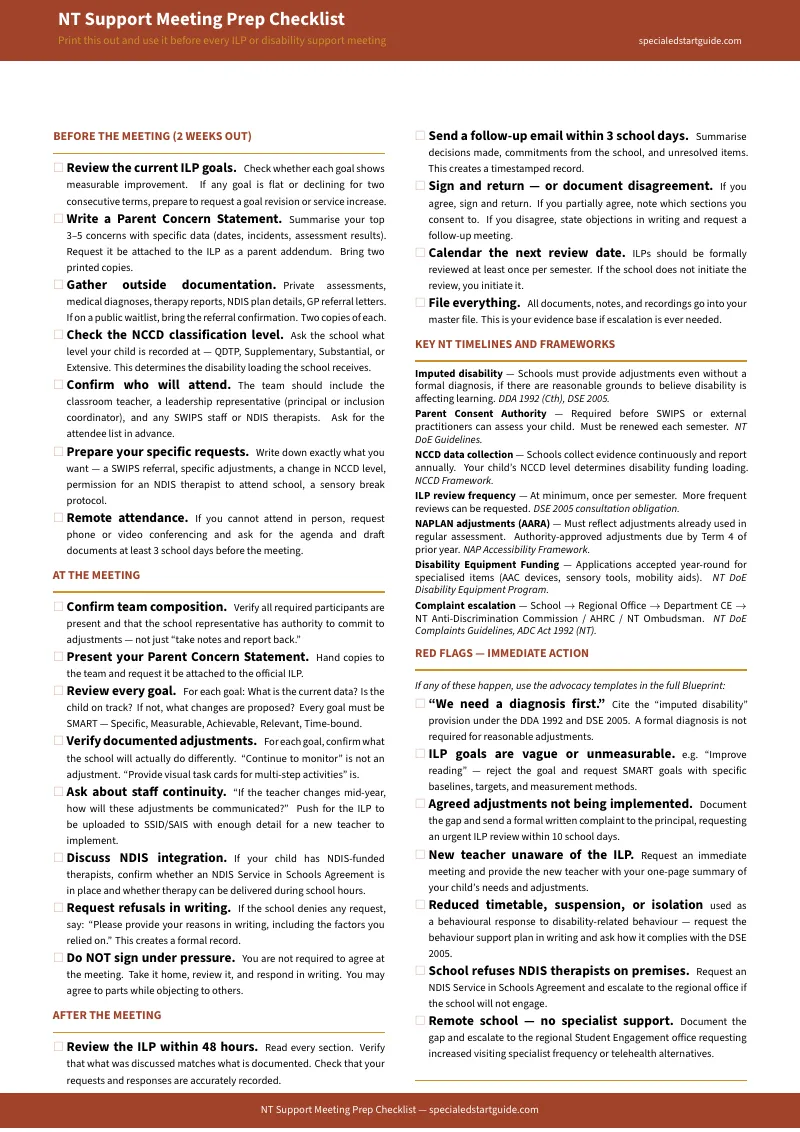
- NT Support Meeting Prep Checklist — the pre-meeting preparation checklist covering what to bring, questions to ask, key rights phrases, staff continuity questions, NDIS integration, red flags requiring immediate action, and post-meeting follow-up actions
- Advocacy Letter Templates — 4 copy-paste email and letter templates citing specific DSE 2005 provisions for adjustment requests, ILP meeting follow-ups, formal complaints to the principal, and complaints to the NT Anti-Discrimination Commission
- ILP Meeting Scripts — word-for-word responses for 7 common school pushback phrases, each citing the specific NT and federal legislation that supports your position
- NT Escalation Ladder — the complete complaints pathway from school principal through NT Ombudsman and Australian Human Rights Commission, with contacts and key facts at every level
- NCCD Funding & Adjustment Reference Card — NCCD funding levels, adjustment examples by level, NAPLAN access arrangements, and key questions to ask at ILP meetings
- Goal-Tracking Worksheet — fillable ILP goal tracker with columns for baseline, target, and progress across all four terms
- NT Resource Directory — every NT contact and organisation on one printable sheet, with a "when to contact whom" quick-reference guide
- Defence & FIFO Transition Checklist — rapid-deployment checklists for Defence families posted to the NT and FIFO/DIDO families managing solo advocacy
Instant PDF download. 9 files total. Print the standalones tonight. Walk into your next meeting prepared.
Money-back guarantee, no time limit. If the Blueprint doesn't change how you approach your child's ILP meetings, email us for a full refund. No questions asked.
Not ready for the full Blueprint? Download the free NT Support Meeting Prep Checklist — a one-page pre-meeting guide with what to bring, questions to ask, and key rights phrases to use when the school pushes back. It's enough to walk into your next meeting more prepared than last time, and it's free.
Your child's next ILP meeting will go one of two ways. This Blueprint determines which one.