
The School Already Has Lawyers. Now You Have the Letters.
Your child's school promised adjustments. They held an ILP meeting, wrote goals, and told you the Learning and Support Team was "looking into it." Three months later, the classroom teacher still has not read the $2,500 psychoeducational assessment you paid for privately. The ILP goals are so vague — "improve social skills," "develop reading comprehension" — that nobody can prove they are not being met. Your NDIS-funded OT needs 30 minutes of classroom observation and the principal refused, citing "operational disruption." You followed up by phone. That was six weeks ago.
You tried the NSW Department of Education website. It explained what reasonable adjustments are. It did not explain what to write when the school refuses them. You called Family Advocacy — the most respected free disability advocacy service in NSW — and learned they are triaging crisis-level cases and cannot service everyday school disputes. Your child's situation is not a crisis yet. But if nobody intervenes, it will be.
The NSW Disability Advocacy Playbook is the structured dispute-resolution system that gives you what the Department's website leaves out: the exact letters to send, the specific legislation to cite, and the step-by-step escalation pathway from classroom teacher to Director Educational Leadership to the NSW Ombudsman to the Australian Human Rights Commission. Every template names the specific NSW institution, cites the specific federal or state law, and tells you exactly who to contact and what to include.
What's Inside the Playbook
The NSW Legal Rights Framework
Three layers of law protect your child — the Disability Discrimination Act 1992 (Cth), the Disability Standards for Education 2005 (Cth), and the Anti-Discrimination Act 1977 (NSW). When the school says "we can't do that," you need to know which law they are violating and which obligation they are failing to meet. This section translates all three into the specific provisions you cite in correspondence — not arguments about feelings, but references to binding legal duties.
11 Copy-Paste Advocacy Letter Templates
Dispute letters covering the situations NSW parents face most often: requesting a LaST meeting, demanding Integration Funding Support applications, enforcing reasonable adjustments under the DSE 2005, sending post-meeting confirmation emails that create binding records, escalating to the Director Educational Leadership, filing with Anti-Discrimination NSW, complaining to the Australian Human Rights Commission, requesting NAPLAN and HSC disability provisions from NESA, and demanding NCCD categorisation reviews. Fill in the bracketed details. Send it tonight.
The Full NSW Escalation Pathway
When the school says no and means it, you need to know exactly who to contact next — and in what order. This section maps the progression: Classroom Teacher → Learning and Support Teacher → Principal → Director Educational Leadership → NSW Department of Education central complaints → Anti-Discrimination NSW → NSW Ombudsman → Australian Human Rights Commission. Each step includes who to contact, what to include, expected response times, and when to escalate further.
Integration Funding Support (IFS) Appeals
The state provides the IFS appeal form but nothing on how to win the appeal. This section explains exactly what evidence the Central IFS panel requires, how to document the failure of current adjustments (the strict prerequisite for approval), and how to align medical evidence with the NSW Summary Profile criteria. When the school tells you IFS has been denied, this is how you fight back.
NDIS-School Coordination Scripts
Your child's NDIS therapist needs classroom access. The school says no. This section gives you the policy-backed language that dismantles the "we don't do that here" objection — the distinction between educational adjustments (school's responsibility under the DSE 2005) and functional supports (NDIS-funded), and the formal correspondence template that forces the school to coordinate or explain its refusal in writing.
The NCCD Funding Accountability Tool
The school is claiming federal NCCD disability loading for your child's support. That funding has conditions — the school must provide documented adjustments for a minimum of 10 weeks. Most parents do not know this. This section gives you the exact question to ask: "What NCCD category and adjustment level are you recording for my child, and where is the 10-week evidence of adjustments being delivered?" Schools respond very differently when a parent understands the funding mechanism.
Discipline and Suspension Advocacy
If your child is being suspended for behaviour directly related to their disability — sensory meltdowns, task refusal from executive function deficits, social conflicts — without a Functional Behaviour Assessment, the school may be engaging in disability discrimination. This section gives you the legal framework and letter templates to challenge punitive responses that treat disability-related behaviour as a conduct issue.
Who This Playbook Is For
- Parents whose child's ILP is not being implemented — the school wrote goals and agreed to adjustments, but nothing has changed in the classroom
- Parents whose Integration Funding Support application was denied and nobody explained the appeal process or what evidence was missing
- Parents whose child lost SLSO hours without warning because the school redeployed the aide to another classroom and claims allocation is "at the school's discretion"
- Parents who paid thousands for a private psychoeducational assessment and the school has not acted on a single recommendation
- Parents whose NDIS-funded therapist has been denied classroom access and neither the school nor the NDIS will take responsibility
- Parents whose child is being suspended for disability-related behaviour without a Functional Behaviour Assessment or ILP revision
- Parents pressured toward a Schools for Specific Purposes placement or part-time attendance without the school first implementing exhaustive mainstream adjustments
- Parents in regional or rural NSW — hours from the nearest support class, specialist psychologist, or Family Advocacy workshop — who need tools that work without professional intermediaries
- Parents at Catholic or independent schools who have been told government disability policies "don't apply" — the DDA 1992 and DSE 2005 apply to every school in Australia without exception
- Parents who have tried every informal approach and need the formal, legally grounded escalation steps
Why Not Just Use the Free Resources?
The free resources are valuable. They are also structurally unable to help you in the moment you need help most.
- The NSW Department of Education tells you the rules. This Playbook gives you the letters to send when the school breaks them — citing the specific legislation the school is violating, addressed to the specific official who is obligated to respond.
- Family Advocacy NSW triages the most urgent cases in the state. If your child is struggling but not in immediate crisis, you face an indefinite waitlist. This Playbook is the advocate in your inbox at 10 PM the night before you need to send a complaint.
- The "Parents' Toolkit" by Disability Advocacy NSW was published in 2013. It predates the modern NCCD funding model, the digitised Access Request procedures, and the 2024 Parliamentary Inquiry findings. This Playbook references the current system — not a system that changed a decade ago.
- Etsy and TPT sell US IEP advocacy templates. They reference IDEA, Section 504, and IEP teams. None of these exist in NSW. Citing US legislation in an Australian school signals that you do not understand the system — and instantly diminishes your credibility.
Free resources explain what the law says. This Playbook gives you the letters that make the school obey it.
— Less Than 10 Minutes With a Private Disability Advocate
A private educational advocate in NSW charges $150 to $250 per hour. Short-notice crisis intervention reaches $350 per hour. Total engagement costs for a single school dispute routinely exceed $2,000 to $3,000. For regional families, these costs are compounded by hundreds of kilometres of travel to the nearest specialist. This Playbook costs a fraction of those fees — and gives you the documented advocacy system to force the school to act on the assessments you already paid for.
Your download includes 7 PDFs:
- Complete Advocacy Guide — 12 chapters covering the NSW legal framework, the dispute resolution hierarchy, ILP accountability tactics, IFS appeals, NCCD funding accountability, all 11 advocacy letter templates, NDIS-school coordination, disability-specific strategies (autism, ADHD, intellectual disability, sensory), discipline and suspension advocacy, building your evidence file, support networks and resources, and a 30-day action plan
- Advocacy Letter Templates — all 11 copy-paste dispute letters as a standalone printable: LaST meeting requests, IFS applications, DSE 2005 reasonable adjustment demands, post-meeting confirmations, letters of concern, formal complaints, Director Educational Leadership escalations, Anti-Discrimination NSW complaints, AHRC complaints, NAPLAN/HSC provisions requests, and NCCD categorisation reviews
- Escalation Pathway — the full NSW complaints ladder from classroom teacher to the Australian Human Rights Commission, with contacts, deadlines, and expected response times — print and keep on your fridge
- Key Contacts & Resources — every NSW phone number, email, and website on a single printable page: Department of Education, Anti-Discrimination NSW, NSW Ombudsman, AHRC, Family Advocacy, disability-specific organisations, assessment clinics, and key legislation
- Evidence File & Progress Tracker — fillable worksheets for organising your documentation, tracking ILP goal progress across all four terms, and monitoring whether agreed adjustments are actually being delivered
- NDIS-School Boundary Guide — the who-pays-for-what reference table, grey area response scripts, therapist access requirements, and information-sharing agreement checklist
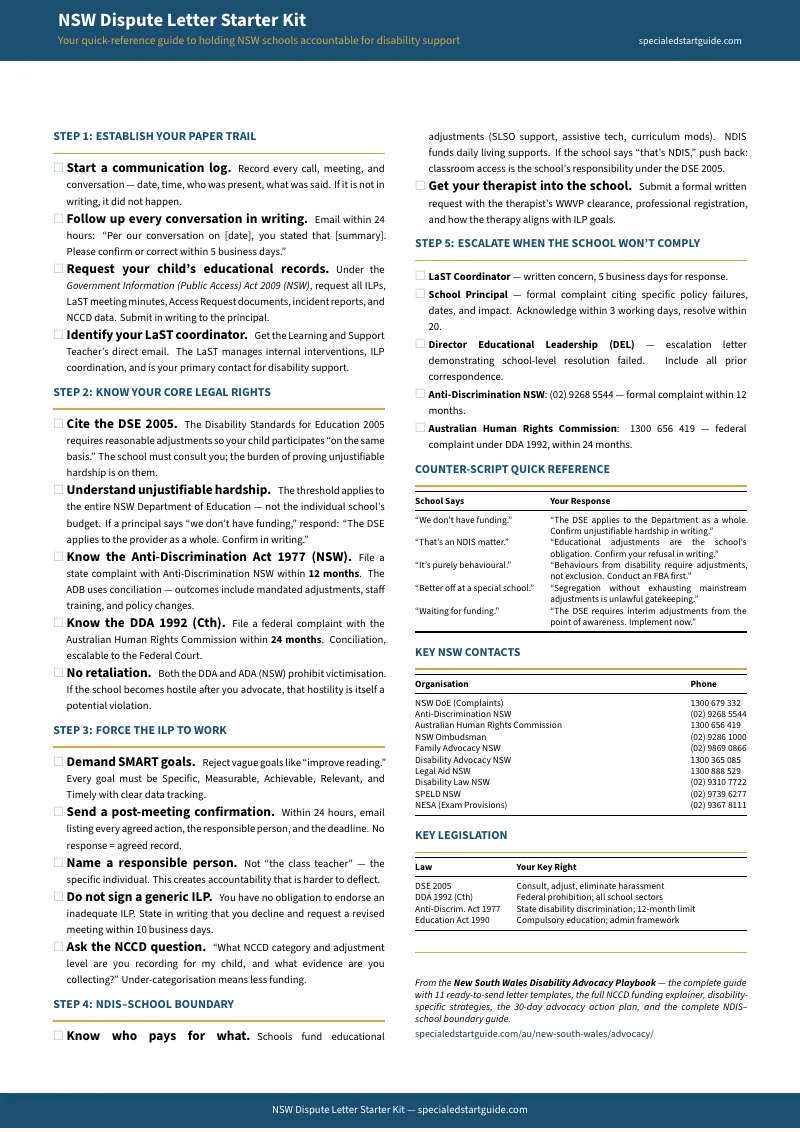
- NSW Dispute Letter Starter Kit — the quick-reference checklist with paper trail protocols, core legal rights with DDA 1992, DSE 2005, and Anti-Discrimination Act 1977 (NSW) citations, ILP accountability steps, IFS appeal checklist, NDIS-school boundary scripts, escalation contacts, and the NCCD funding question every parent should ask
Instant PDF download. Send your first dispute letter tonight. File your first complaint this week.
Money-back guarantee, no time limit. If the Playbook does not change how you handle your child's disability education disputes, email us for a full refund. No questions asked.
Not ready for the full Playbook? Download the free NSW Dispute Letter Starter Kit — a quick-reference guide with the paper trail checklist, core legal rights, IFS appeal steps, key contacts, and the NCCD funding question that forces transparency. It is enough to send your first documented follow-up email tonight, and it is free.
Every day without a documented paper trail is a day the school claims compliance. Your child's next dispute does not have to be fought alone.